Horus 39: December 3rd 2016 Flight Report

logottgc


On Saturday December 3rd 2016, the Amateur Radio Experimenters Group launched the Tea Tree Gully Library mascot, Anstey the Echidna into the stratosphere as part of her next big adventure. In the past 12 months Anstey the Echidna has been to France, Italy, Ireland, Japan and New Zealand.

Flying an Echidna into near space is not without its challenges. It took a very large team of people from the Project Horus group within AREG, as well as a large number of amateur radio operators from across SE Australia to achieve this feat.

Launch Preparations

The first stage of the journey was to build the craft that would carry Anstey into the stratosphere. Mark VK5QI and Matt VK5ZM worked some long hours preparing the vehicle to make sure that not only would Anstey get a perfect view, but that those of us on the ground could also share her experience.

The cameras used included a GoPro Hero 3 and a Raspberry PiCam connected to the Wenet 115kBit/s 50mW data transmitter. This was only the second full flight of the Wenet system which has been co-developed by Mark VK5QI and David VK5DGR using an FSK modem developed by the team with help from Bill VK5DSP. (more on this shortly).

Balloon Launch Crew

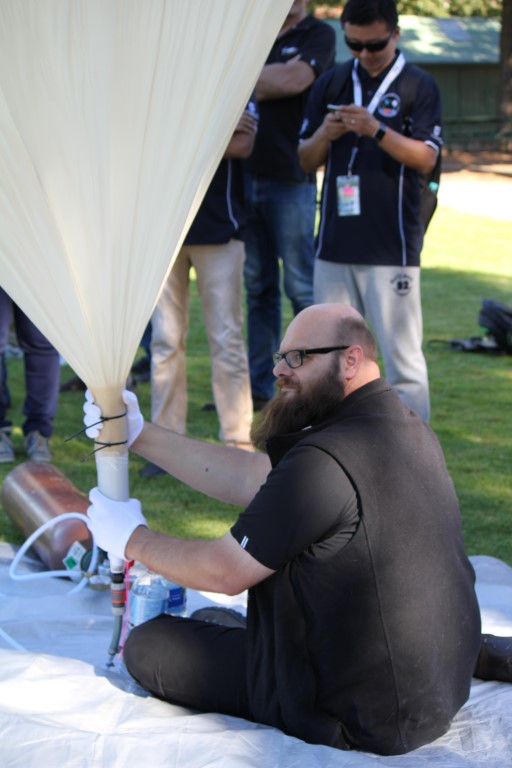
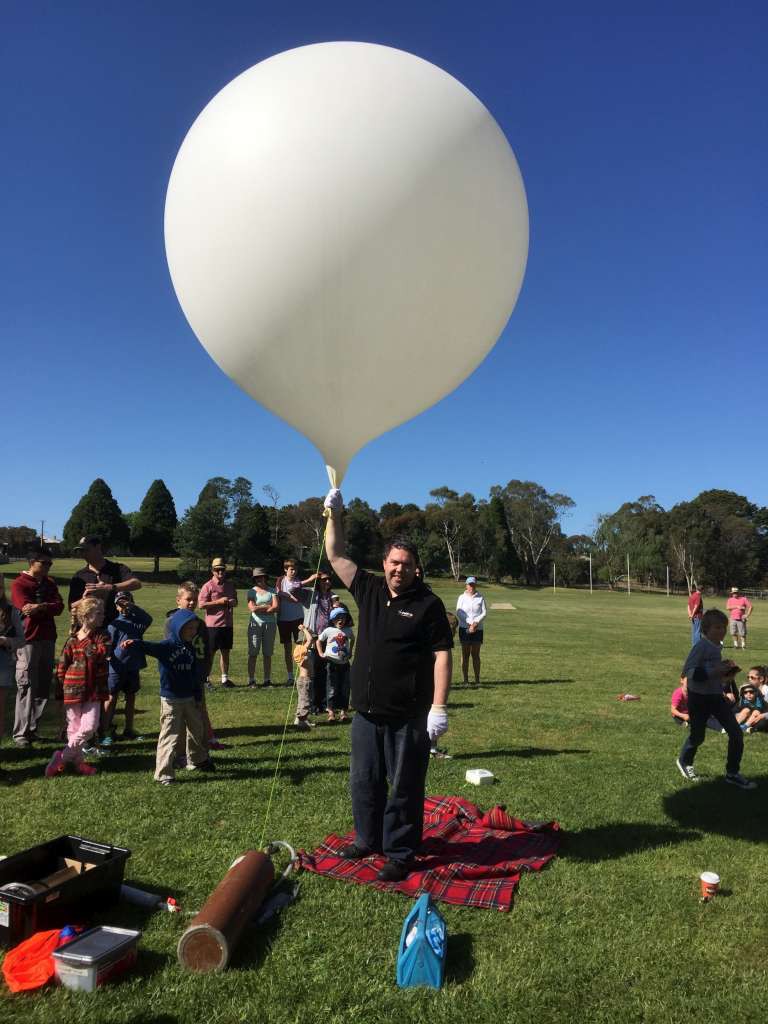
On the ground, we had a large contingent of members from the Project Horus team. Matt VK5ZM lead the assembly of the balloon payload train while Mark VK5QI, Grant VK5GR, Kim VK5FJ and Gary VK5FGRY set about filling the balloon.

After the “Balloon meets tree” incident during Horus 38, we added an extra safety measure, with the release of a sounding balloon before the main launch.Grant VK5GR’s daughter, Amelia, did the honors.

Finally, the team from the Tea Tree Gully council started their Facebook live broadcast back to mission control and we prepared to send Anstey off into the sky on her epic journey.

Mission Control – Tea Tree Gully Library

Back at the library the staff had setup vk5bb-library“mission control” for the morning. Ben VK5BB and Olga VK5FOLG from AREG represented our club at the library and introduced themselves to David Brooks who organised the event. Ben goes on to report:

“David then performed the introductions, giving a little bit of history of the Tea Tree Gully area and how he believes that the local population growth was tied to events within both the USA and USSR space programs. In the back ground we were watching a number of video clips from the Launch site, looking at the equipment, Matt explaining what all the equipment in his vehicle was for, Mark explaining the tracking facilities in his car and the reporter doing his bit at launch time. 

David then introduced  Dr. Brent Gooden who was an expert in a number of fields, space suits, space medicine and Echidnas! He talked about how the Echidna was very well adapted physiologically wise to be able to take the rigors of space travel, all tongue in cheek but very well presented. Mean while on the wall behind the speakers, the images of Anstey were being displayed as they downloaded. Very nicely done!

Then I was invited to the rostrum to give a plug for AREG. I spent about 5 minutes talking about the history of AREG, Project Horus, that AREG was a “young” club and have a focus on radio technology and encouraging young people to look at STEM in their education which was well received.

I was well thanked by David and he publicly acknowledged that without AREG and Project Horus, this event would not have happened.”

Flight Ground Tracking Network

The next major component of the event was the flight ground tracking network. To retrieve the transmitted images from the balloon, we had positioned several stations around the state equipped with RTL-SDR dongles, pre-amps and the receiving software designed to collect the Wenet 115kBit/s telemetry stream. Station No.1 was Peter VK5KX and his partner Wendy, who camped on top of a hill overlooking Palmer on the eastern face of the Adelaide Hills.

tracking-data-recovery-centre-vk5kx

Ground Control Palmer – VK5KX

vk5kx-tracking-central

Ground control inside VK5KX

Peter reports “Wendy & I drove up to Palmer Saturday morning. We had to do some extra km’s due to chain of ponds road being closed, however we got there and rushed the setup completing everything in a nick of time. We were getting SSDV images before we had a lock on the balloon RTTY payload.

just_before_landing-mediumPointing the 5 element 70cm beam at a point in space to Rx the SSDV images was no easy task. I tried using a compass app on the phone, even a Theodolite app, but they were both giving erroneous readings, so I reverted back to a handheld magnetic compass. I did mange to get used to it and made a few notes as to where to point the beam and at what angle of elevation.  Some perfect images were decoded and uploaded.

After the balloon burst, we manageburst_and_parachute-mediumd to track it for some time before starting to have some issues decoding the RTTY. I could see the data clearly but the fl-digi window stayed red, only occasionally going green. To be investigated later. We went on to camp on the hill that night in preparation for Horus 40 on Sunday morning.

When Sunday arrived, the weather appeared with a vengeance. The winds
were so fierce that they nearly blew us away. It did managed to blow some seats and gear down the hill. Unfortunately in it’s path was the beam antenna on it’s tripod. I now need to do some maintenance on the beam.  I notified the Sunday launch crew that we were pulling the plug and then the fun began as we tried to expediently get all the gear in the bus somewhere. Then the rain started too, as I ventured 2/3 the way down the hill to retrieve a red plastic box, the trip back to the bus against the wind & uphill wasn’t pleasant…..”

Bob VK5FO and Ray VK5RR operated ground control No.2 from their home near Waikerie in the Riverland. Bob reported:

“at the last minute before the Launch, we were able to borrow an RTL-SDR and Pre-Amp in order to set up an additional station to RX the SSDV pictures from the Balloon. The RX station was set up in the Riverland, near Waikerie and was reporting Telemetry and Image data as VK5RR.

20161202-141417z-medium 36km_altitude_pic-medium

Given that the site was about 100km+ away from the flight path, it was actually an unknown if it would even RX any data. We monitored the flight data and once the Balloon hit around 6,000M we started to RX some telemetry. It was noted that once the signal got to around 6 or 7db above the noise floor it was getting consistent decodes.

Now, the Antenna used was not ideal – it is a typical “white stick 2/70 Dual band antenna, around 25M of RG-213 before the Pre-Amp. Once we were getting good decodes the RX site was left  unattended for the rest of the flight. We contributed to the image data on SSDV.habhub.org and noticed that at around the 27,000m mark  we lost RX of the image signal.  This was probably a null in the Antenna – given that this was probably around the 25 Degrees elevation from the RX location.

After the Balloon burst, we again started to RX Image data, and this time it was right down to approx 2,000M (at over 140km away).

On checking the recorded images, we had partial data on several, and nearly 100% of others.  A total of 127 Images (complete and partial) were received, and a total of 253 images of the flight were recorded and uploaded.  The RX site provided image data for around 1/2 of the images of this flight.”

We also had Kim VK5FJ receiving the balloon from Mt Barker as well as the two mobile recovery vehicles with VK5QI and VK5ZM, all who contributed some data to the successful images relayed back to Mission Control live from the balloon.

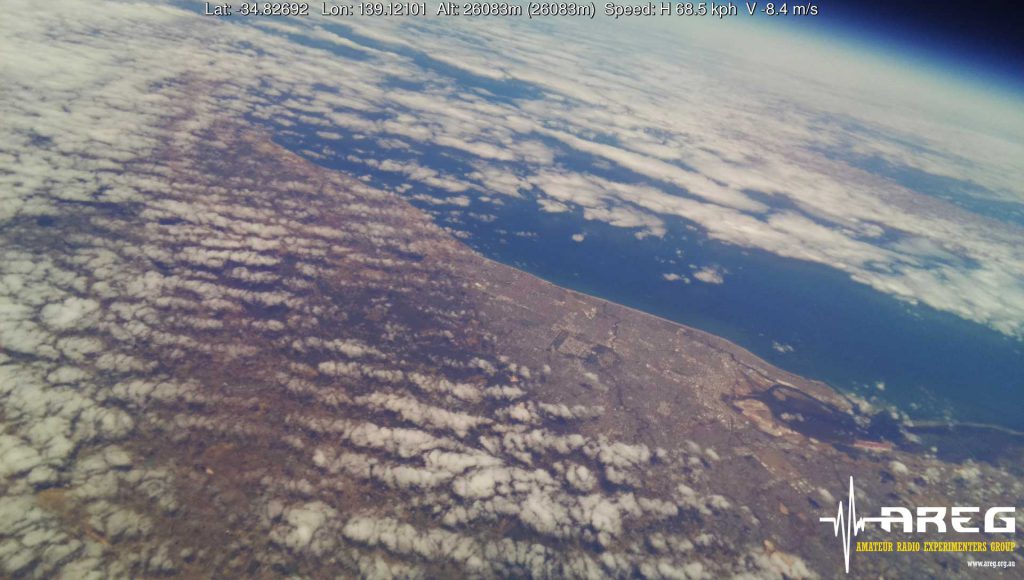
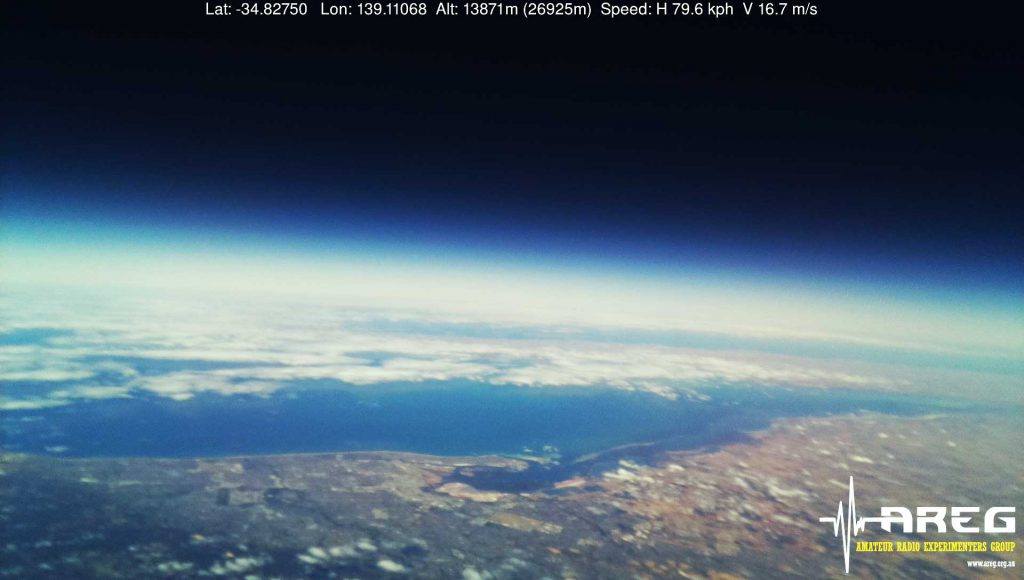
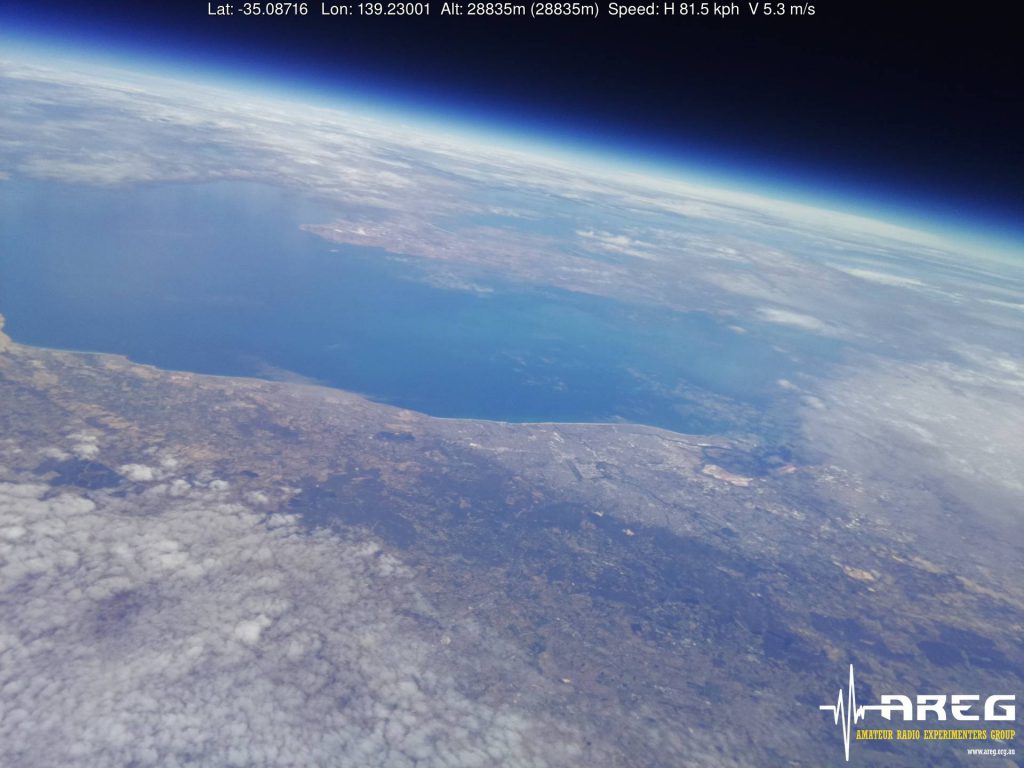
The following animation is compiled from the still images collected from the balloon SSDV telemetry system.

More details about the Wenet system designed by the Horus team and the SSDV platform provided by UKHAS and Phil Heron can be found elsewhere on the AREG site.

Flight Statistics

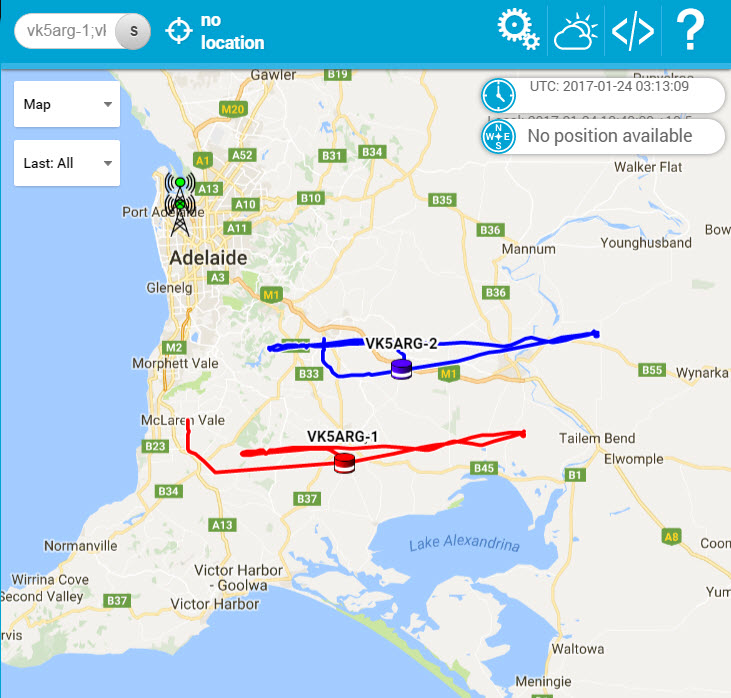
The flight itself was almost a text book affair. The flight track can be seen in the following animation created by Grant VK5GR from the telemetry raw data.

The vital statistics are:

[table “” not found /]

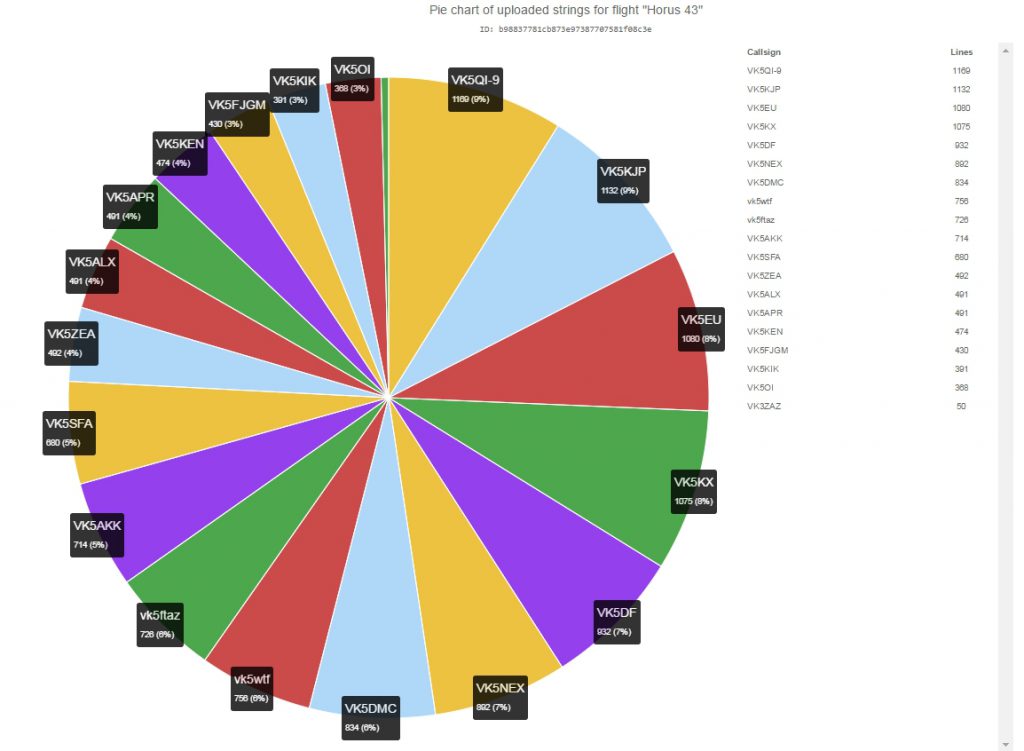
The team would like to thank all of the following stations for their contribution to the  telemetry collection effort:

VK5APR, VK5EU, VK5FTAZ, VK5KJP, VK5KX, VK5NEX, VK5PJ, VK5QI, VK5RR, VK5ZEA, VK5ZM

Recovering Anstey – in a field of Triticale

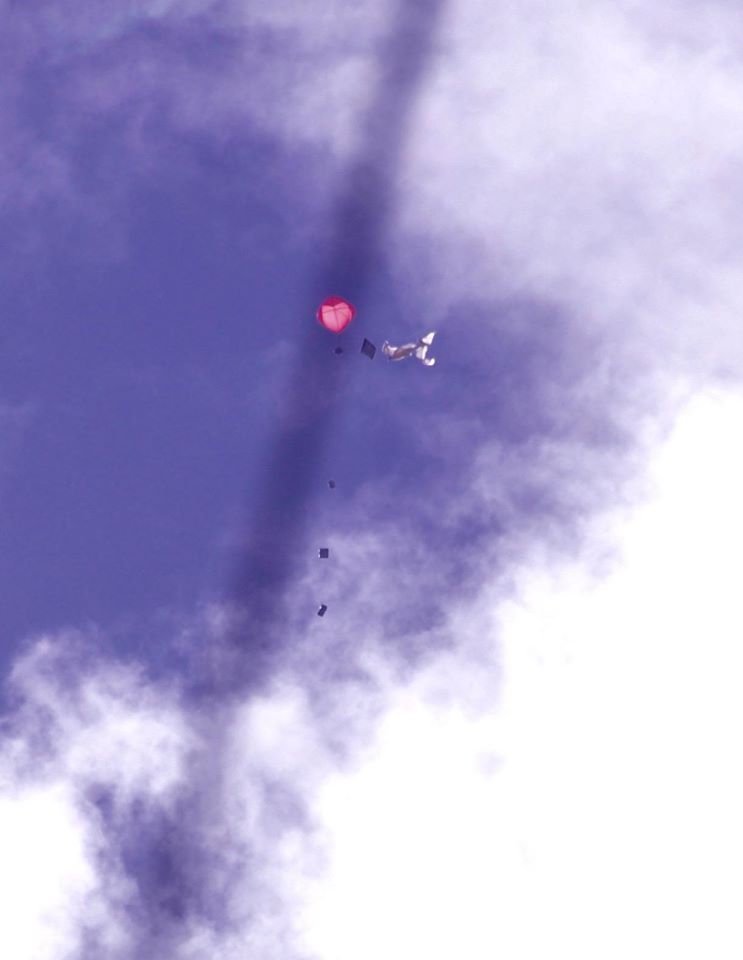
burst-mediumThe final act was for the balloon to burst and for Anstey to return to earth to tell her tale. The mobile tracking crews, based on the available predictions, had headed for Lameroo in the Murray Mallee about 250km east of Adelaide. Once the balloon burst however, we discovered that it was falling faster than predicted.

We determined that again the burst hadn’t been a clean one (confirmed with one of the SSDV images we collected) and along with the payloads, a large chunk of the balloon was coming back still attached! The drag of the parachute slowed the descent, but not as slow as originally planned, with the payloads eventually returning to earth at ~9m/s. This caused something of a scramble among the tracking teams as the landing suddenly looked to be about 30km short of where we expected. Fortunately, we weren’t that far away when it touched down, and a good fix from the beacons was obtained before the landing.

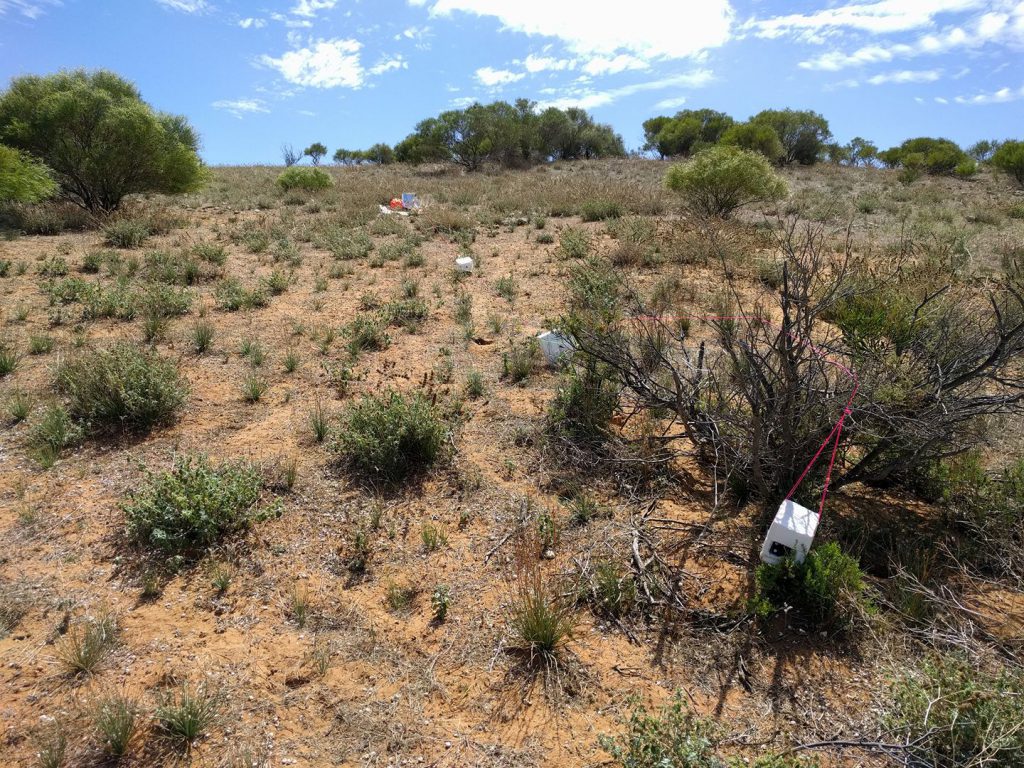
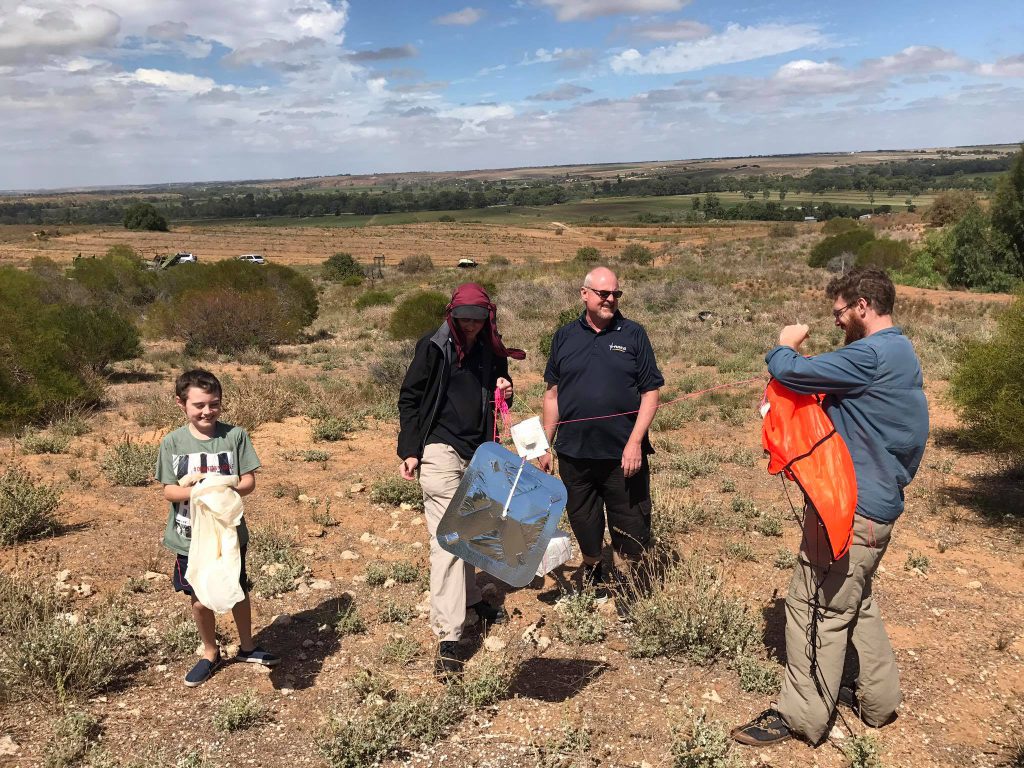
After about 20 minutes, we had located the land owners, who were curious to see what we had landed on their property. They were very helpful and friendly farmers who lead us to the landing site in our vehicles. We should have been able to drive right to the payload, except at the critical moment, the telemetry computer crashed in the VK5ZM chase car. So, out with the yagi and direction finding gear to find Anstey the old fashioned way.

After a further 15 minutes, and a hike across a 1m high crop paddock, Anstey was found safe and well.

Conclusion

Everyone declared Horus 39 a success, and looking at the comments and feedback received via social media, it would appear it was very well received by the amateur radio community across Australia as well. We are looking forward to the next time we can fly and hope you will come on the journey too! 73 de Project Horus, Adelaide!

HORUS 40 Balloon Flight: Sunday 4th Dec – CANCELLED

horus-logo-blackThe flight planned for today had to be cancelled at the last minute due to the weather conditions at the launch site. Heavy rain and high winds just as we were to start filling the balloon forced us to call a halt to the proceedings.

The planned flight will now be rescheduled for the first few weeks back at school in the new year (first week of February is being considered)..


It is a very busy weekend for the Project Horus team within the Amateur Radio Experimenters Group. Yesterday (Saturday) we flew a payload for Tea Tree Gully Council Library. Today (Sunday) we are flying a STEM (Science, Technology, Engineering & Mathematics) payload through LaunchBox for a local Adelaide high school.

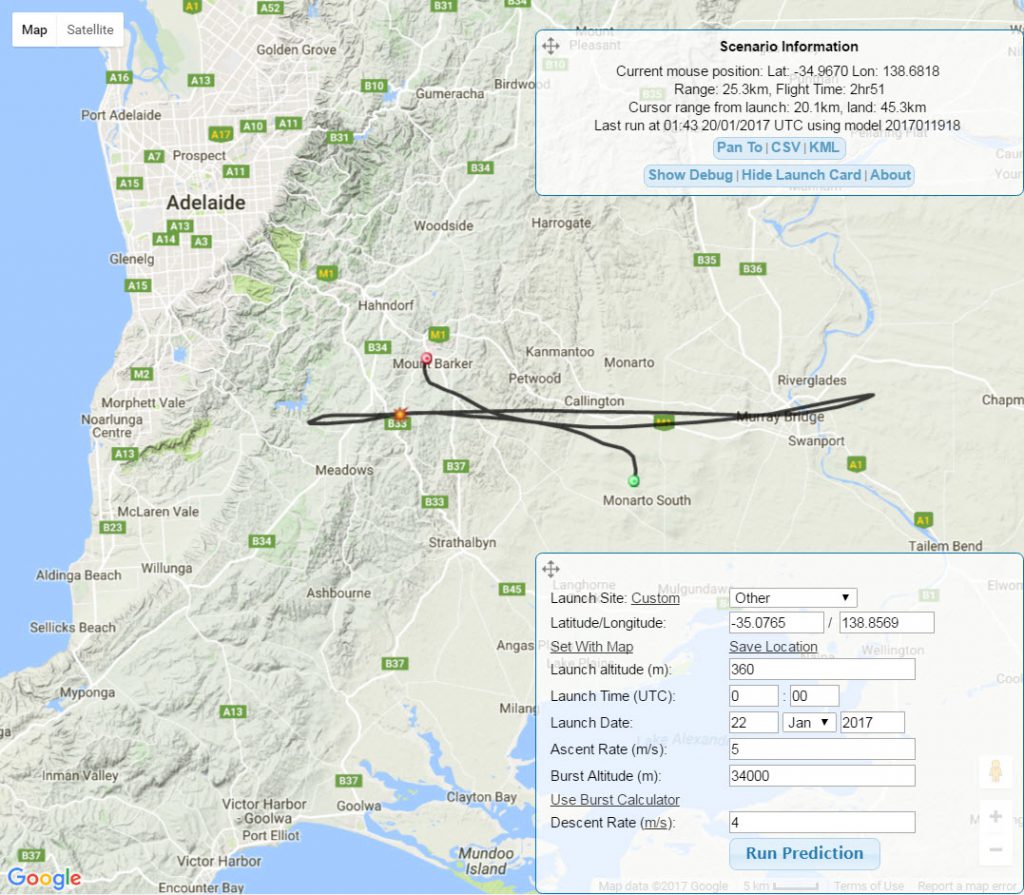
The predicted flight track for Horus 40 is below.

flight-track-satnight

The parameters being considered for this flight will make it a fast one, as we are aiming to prevent it landing in the inaccessible territory at the western end of Ngarkat Conservation Park, plus we have some less than favorable surface launch conditions to deal with in the morning according to the Bureau of Meteorology.

Horus 40 Flight Details

Liftoff is planned for 10AM ACDT from Mt Barker High School. The payloads will be:

  • Standard RTTY Telemetry: 434.650 MHz, 100 baud ASCII-7N1
  • Wenet Imagery Payload: 441.200 MHz
  • LaunchBox payload
  • Flight Path Management and Control Payload

Tracking will be available via habhub.org habhublogo

SSDV imagery will be available via ssdv.habhub.org/VK5QI

How can you get involved?

Amateurs across SE Australia can contribute to the flight through RTTY telemetry data collection and forwarding to the Internet. Multiple members of AREG are also involved collecting the SSDV imagery data from the 115kbit/s high speed downlink. Follow the links from HabHub or on the AREG website for more details.

Anstey Echidna’s Balloon Flight – TODAY (Horus 39)

Launch Preparations to fly Anstey the Echidna  into space are continuing. Her spacecraft is ready and flight plans are being reviewed ready for liftoff.

The AREG group who are flying this payload for the Tea Tree Gully Library have been working feverishly in the background building the payloads to carry Anstey on her epic journey. Mark VK5QI has worked some long hours to get everything ready, as has many members of the Amateur Radio Experimenters Group looking to receive as much of the SSDV imagery as possible.

Launch is planned for 11:00am Saturday (barring unforsean circumstances). The Amateur Radio Experimenters Group will have both it’s launch and chase teams on site from 10:00am to make the final preparations.

prediction-friday

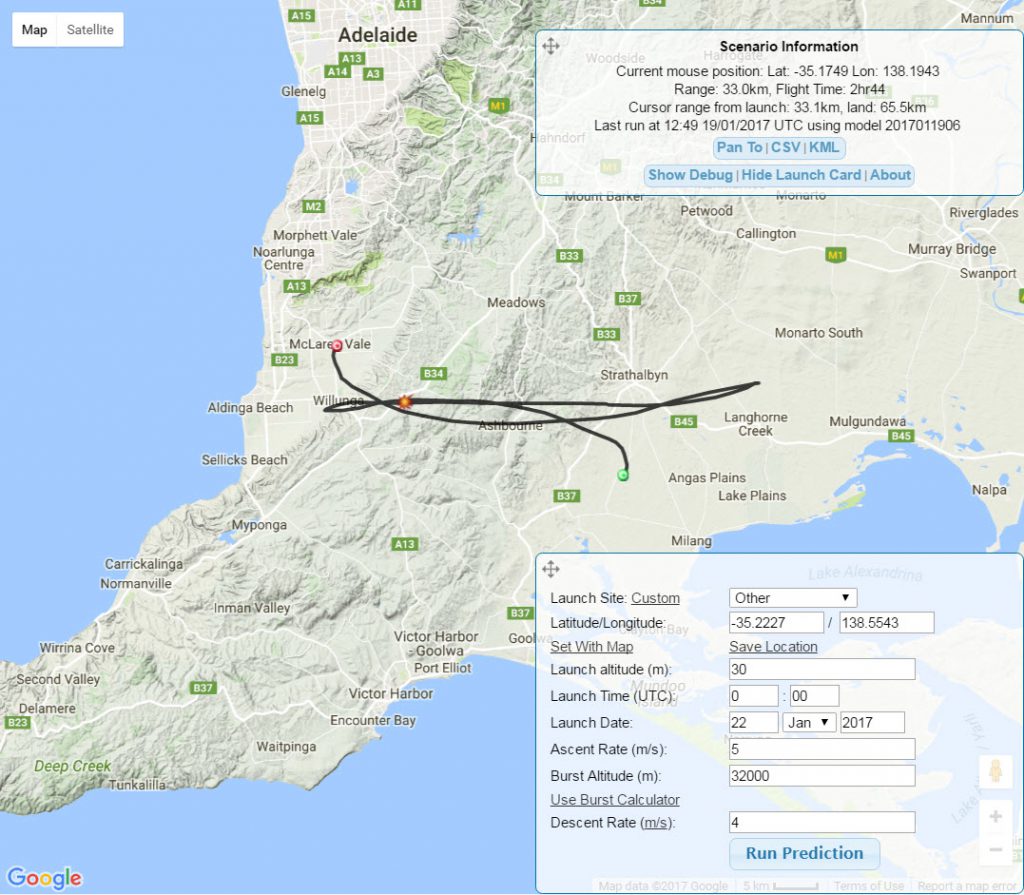
The flight track prediction is also now firming up. It looks like it will be a long drive, with landing predicted to be north of Parrakie on the Adelaide to Pinnaroo road. Stations as far away as Melbourne should be able to hear the telemetry beacon as the balloon reaches apogee.

You can track the balloon payloads via one of the channels below:

  • Standard RTTY Telemetry: 434.650 MHz, 100 baud ASCII-7N1
  • Wenet Imagery payload: 441.200 MHz

This is the live track imagery.


How can you get involved?

The Horus telemetry system is based on a “distributed listener” principle with multiple receivers listening for the same frames, increasing the chance of picking them up correctly. Amateur Radio operators across SE Australiahabhublogo are encouraged to set up their 70cm receivers and tune to the 100 baud RTTY telemetry frequency of 434.650MHz.

The more people we have collecting telemetry data and forwarding it to the internet, the greater the chance of us recovering the payloads!

Instructions of what software to download and use to decode the telemetry and forward it to the Internet can be obtained from the habhub,org website.

Live Online Tracking Links

Tracking System Overview2


Also DONT FORGET, there is another balloon flying on Sunday for Launchbox – details to follow!

Balloons Balloons Balloons – Two Launches next weekend!

horus-logo-blackProject Horus is having a very busy month! Next weekend, Saturday 3rd and Sunday 4th of December we are flying a balloon on each day for two separate groups.

Saturday 3rd December – Tea Tree Gully Council – Horus 39

AREG was approached recently by the Tea Tree Gully Council Library to undertake a rather unique balloon flight. Their mascot, “Anstey the Echidna” wanted to go into space, having already been around the world to France, Italy, Ireland, Japan and New Zealand. Of course the Project Horus crew was happy to oblige!

Tea Tree Gully Library - Anstey in Space

Tea Tree Gully Library – Anstey in Space

We are hoping to not only record the film of Anstey’s journey on a GoPro camera, but the images from the flight are also going to hopefully be beamed down to earth live over the new ‘Wenet’ SSDV system that the project team is developing. Amateur Radio operators will be able to help out with the flight through telemetry collection from across SE Australia.

Horus 39 Flight Details

img_20161113_101045

Anstey checking out the previous flight, learning how it is done!

Liftoff is planned for 11:00am ACDT – 3rd December from a location near Mylor in the Adelaide Hills. The payloads will be:

  • Standard RTTY Telemetry: 434.650 MHz, 100 baud ASCII-7N1
  • “Anstey” the Space Echidna. + GoPro HD Hero 3
  • Wenet Imagery payload: 441.200 MHz
  • Emergency Jettison Module (in case Anstey’s spacecraft fails)

Anstey’s flight path is predicted to take her at least 30km up into the stratosphere, and roughly 150km down range into the Murray Mallee. AREG and North East Radio Club members will be tracking the flight from a number of locations, and will have chase teams following Anstey on her journey.

horus39-earlyflightprediction


Sunday 4th December – LaunchBox – STEM in Schools Program – Horus 40

The second flight of the weekend will take place on Sunday 4th December. This is a flight for LaunchBox for one of the Schools here in Adelaide. Once again student science experiments will be flown, hopefully inspiring more young people to take up a career in science.

Horus 40 Flight Details

Liftoff is planned for 10AM ACDT from Mt Barker High School. The payloads will be:

  • Standard RTTY Telemetry: 434.650 MHz, 100 baud ASCII-7N1
  • Wenet Imagery Payload: 441.200 MHz
  • LaunchBox payload
  • Flight Path Management and Control Payload

How can you get involved?

The Horus telemetry system is based on a “distributed listener” principle with multiple receivers listening for the same frames, increasing the chance of picking them up correctly. Amateur Radio operators across SE Australiahabhublogo are encouraged to set up their 70cm receivers and tune to the 100 baud RTTY telemetry frequency of 434.650MHz.

The more people we have collecting telemetry data and forwarding it to the internet, the greater the chance of us recovering the payloads!

Instructions of what software to download and use to decode the telemetry and forward it to the Internet can be obtained from the habhub,org website.

Live Online Tracking Links

Tracking System Overview2

AREG at the WIA STEM Symposium – November 2016

The Amateur Radio Experimenter’s Group has taken an active role in promoting STEM in Schools programs for a number of years now, particularly through our involvement with LaunchBox, who work with us and our Project Horus sub-group to fly high altitude balloons. Our recent foray into the Maker Faire and HackerSpace community through our participation in the Adelaide Maker Faire also has been an area where we see a great potential to improve the link between Amateur Radio and STEM in schools, particularly with secondary and tertiary level students.

AREG Road Trip to Canberra

It was against this backdrop that the group endorsed it’s President, Matt VK5ZM and Treasurer Grant VK5GR to make the 2400km round trip from Adelaide to Canberra to attend the inaugural WIA STEM symposium.

AREG saw this as an opportunity to firstly share it’s own experiences with others, as well as build networks with other like minded amateurs who either were already engaged in their own contact with the STEM programs in schools or who were wanting to initiate programs of their own. The group also saw this as a way of tapping into the resources of the WIA to help facilitate the communications between affiliated clubs engaged in these activities, and also as an opportunity to contribute to resources that the WIA could develop to support the regional clubs in their STEM endeavors.

The speakers at the Symposium

The event itself, enabled through the hard work of the Canberra Region Amateur Radio Club on behalf of the WIA, provided a fascinating insight into the world of STEM and the challenges STEM faces in schools. (Thanks in particular to Amanda VK1WX, CRARC president).

The WIA Introductions

AREG received presentations firstly from Fred Swainston VK3DAC on the WIA’s vision of STEM, followed by one technological idea from Phil Wait VK2ASD on kits that could potentially be made available to schools based around cheap RTL-SDR Dongles as a way of introducing radio spectrum and communications studies into schools.

Geffory McNamarra wins PM’s Science Prize

STEM from a Science Teacher

Next up was a presentation by Geoffrey McNamara, a science teacher from Melrose High in the ACT who has been doing amazing work encouraging students to take an interest in science based investigations in secondary school. Geoffrey has implemented a program along an apprenticeship model where he has brought in experts from their fields to work with students one on one in a field of research. Many of those who are lucky enough to go through that program have gone on to a career in science.

Two principle points however came out of talking with Geoff that any initiatives need to take into account.

  1. You need to show students the “Wow Factor” behind any scientific endeavor, to spark their interest and light the fire to drive them to take it further.
  2. Science Teachers are incredibly time poor and severely under funded.

Radio Astronomy and STEM

The Lewis Center provides the gateway to this program via JPL

Next the participants received a presentation from Dr David Jauncey, talking about programs like GAVRT (Goldstone Apple Valley Radio Telescope) where students in the USA can access a decommissioned radio telescope at the Goldstone Deep Space Network station in California. He also discussed how Tidbinbilla in the ACT is engaged in some schools programs (although not to the extent that Goldstone is). Out of this it was again clear that the principle aim of STEM programs is to garner that spark in students that science is “wow” and has something genuinely interesting and inspiring to offer as a career or at the very least as a life skill and perspective.

Practical Science and Physics Experiments enabled by Amateur Radio

Next up was Dr George Galanis VK3EIP, who is attempting to construct a system that could be used to demonstrate practical physics experiments using radio at schools. His idea is that you take a portable EME station to a school and conduct experiments such as measuring the echo delay from the moon, and even bouncing SSB voice off the moon and letting the students gain a real appreciation of the time delay involved in transmitting radio waves that far into space.

Other uses of the same equipment were also discussed in the field of radio astronomy. The ability to look at the microwave radio noise from the sun and show how to calibrate the dish, as well as other radio astronomy experiments are all practical demonstrations of radio that are relevant to the classroom. Again, the underlying theme to come out of this was to find ways to spark an enthusiasm in students and give them a memorable ‘wow’ experience, to implant science and technology as something worth following up later in life through tertiary studies and beyond, was the core theme of Dr Galanis’s presentation.

Accessing STEM through the Maker and Hacker-Space Movements

The final formal presentation was given by Matt and Grant from AREG. Matt opened with a story about a conversation he had once with a good amateur radio friend, Harro VK5HK (sk). Harro once asked Matt “What is radio?” Matt gave a very engineering focused answer about Maxwell’s equations etc, to which Harro politely pointed out “Yes, but no…. What is it really?” he asked again rhetorically? “Magic” was his answer.

It is the magic of radio, and getting people to the realization that it really is a form of magic that was the “wow” moment amateur radio can bring – when presented in the right way. It is the magic of being able to talk into a box on one side of the globe, and have someone on the other side talk back. When you think that there is no other infrastructure in between, and yet this is still possible, then you again have that hook or spark that leads to a “Wow” moment in young people that you hope will stick with them throughout their years. Undertaking that sort of communications in inventive and awe-inspiring ways, such as talking to ISS, or via live TV where the internet is not involved is a definite opportunity to “light the fire of imagination” in young people today.

It was this theme of “Radio is Magic” that Matt and img_3237-mediumGrant spoke to, explaining how they had brought amateur radio to young people through things like Amateur Television at JOTA, or through High Altitude Ballooning via Project Horus that members of AREG have been involved with now for nearly 6 years. The very recent foray into the Maker Faire and the group’s contacts with people in the Hackerspace movement were also discussed.  It was shown how lighting that spark even as people are in their tertiary studies was a way to leave a lasting impression and would and does lead to people taking up Amateur Radio in their twenties – a key demographic that AREG sees as fertile ground to recruit into amateur radio and to also promote the ongoing relevance of amateur radio today.

The high altitude ballooning in particular was discussed in some detail as a way of engaging with schools programs. The AREG representatives explained how that had worked through LaunchBox as a great way to inspire even primary school children to develop a wonder of science. The example of how the Project Horus balloons have been used to fly simple experiments to answer a child’s question of “will my corn kernel turn into popcorn in the near vacuum of near space?” hits home to how activities like this can spark someone on a journey of scientific curiosity that will potentially stay with them for the rest of their lives. (By the way, sadly the answer was no – the corn stays as a corn kernel).

One particular STEM area that was then discussed was that there are multiple facets to how you engage with STEM in schools. The obvious way is to undertake direct interactions with students, and you can also take the second tier approach and market amateur radio as a tool to the science teachers themselves. There are conferences and science fairs around the nation completely untapped by amateur radio where with the right presentation, the magic of radio could reach the classroom by recruiting the teachers who are already there. As a result, there was discussions around 1) trying to identify existing teachers who hold a license and 2) looking further at avenues and support requirements to recruit new teachers into the hobby, so as to enhance that conduit into the classroom as well.

Where to from here?

After the presentations the symposium broke for lunch, during which many useful discussions were had. After the break, we went back into the hall and broke into three working parties. The aim was to develop initial ideas around the following three questions:

  1. The Way Forward to further develop the concept
  2. Promotion and Marketing that can be developed by the WIA
  3. Other Technologies not identified at the Symposium

Lots of good ideas were put forward and are now being collated by the WIA for distribution. The WIA indicated that all of the presentations that were made, the papers that were received and the data generated from the three working parties will be made available in due course via the WIA website.

Conclusion

Overall, Matt and Grant came away feeling that the WIA had made some good first steps into addressing how to get amateur radio engaged with STEM in schools. It also was clear that this is not an initiative that can be driven solely by the WIA. It will take the formation of teams of people in each state and territory who can then begin the work of building local responses in alignment with a national Amateur Radio in STEM framework. The WIA can play a facilitation role here that will be positive for both Amateur Radio and STEM education in Australia.

The next step AREG see’s is that the WIA needs to establish an Amateur Radio in STEM advisory committee, made up initially from the general WIA members who attended the symposium plus others who couldn’t make it but still wish to contribute. This committee needs to take the work already started and complete building the national frame work for Amateur Radio in STEM. It can then turn that into a set of individual regional initiatives driven through the radio clubs network so that collectively the Amateur Radio Service can set forward on the task of tackling this multi-faceted arena.

AREG would like to thank the WIA for taking the time to run the symposium and in particular would like to thank all those who made the effort to attend and participate, as well as thank those who contributed papers and inputs. It is hoped that this is only the beginning of a new focus on how to demonstrate to a new generation the ongoing relevance and importance not only of Amateur Radio to the country, but also STEM education in general in Australia. Getting everyone together in one place was a fantastic start to this as it has established new networks and shared many different perspectives on how to tackle the issue. There very much is an exciting future ahead for Amateur Radio and STEM studies nationally.


Horus 37: Flight Success!

We are pleased to report that the high altitude balloonhorus-logo-black flight of Horus 37 has been a success. The AREG Project Horus launch crew carried out the flight for Launchbox, a group which engages with the STEM programs (Science, Technology, Engineering, Math) in schools across the state.

http://www.launchboxspace.com/

Lift off was from Mt Barker High School at 10.00am, with landing occurring approximately 15km east of Mannum about 3 hours later.

8 payloads went aloft this flight. 5 from Launchbox and 3 from AREG. The new one for AREG was the experimental SSDV transmitter, which delivered live images from the balloon for a portion of the flight.

Launch

Launch was conducted under challenging conditions with squalls and wind gusts arriving about 20 minutes before liftoff. This caused considerable consternation from the launch team who were for a few minutes at risk of loosing or damaging the balloon before we had even gotten off the ground. However, through the skillful handling of the balloon by the AREG team, catastrophe was averted.

Once the balloon payload train was assembled, the countdown got underway. The weather eased and the flight finally got away safely.

Images from the Flight Ground Preparation and Launch

The Flight

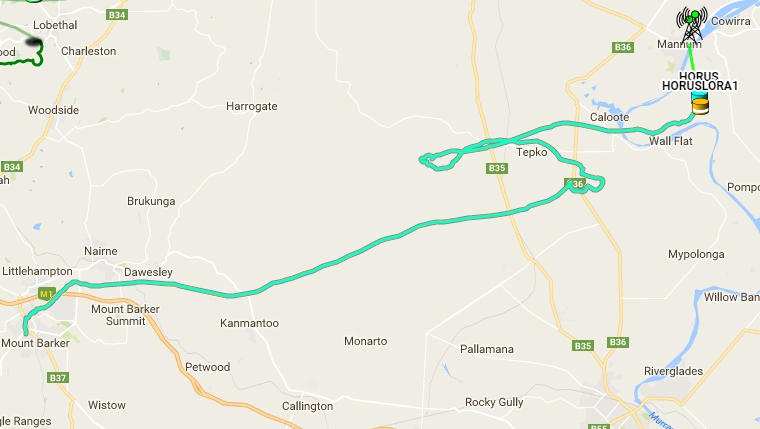
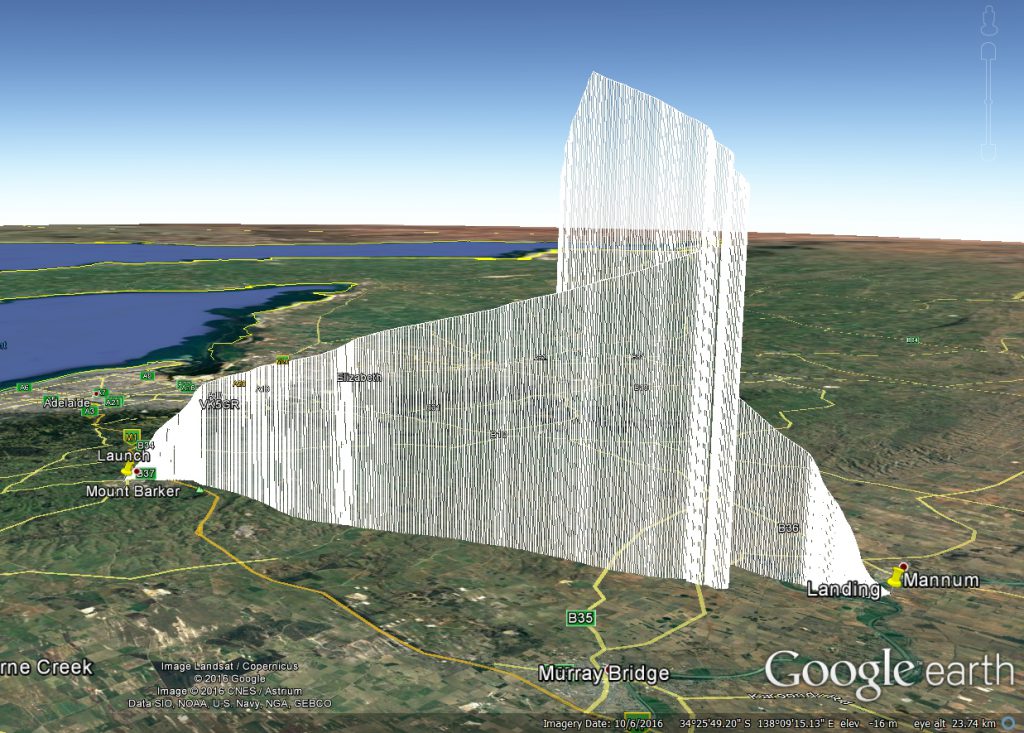
The flight itself went well, although it had to be terminated earlier than planned. The team did not want it landing in the River Murray.

trackplot

Flight Track from half way through the flight

habhubtrack

Final Balloon Track – www.habhub.org

Lots of stations participated in the telemetry collection (thank you for your contribution).

SSDV Experimental Payload – ‘Wenet’

As indicated above, this flight carried a first time payload for AREG. Mark VK5QI and David VK5DGR have been working on a slow scan digital image payload for the balloon system which alternates between 19.2kbit/s and 115kbit/s on a new downlink channel. This system makes uses of the UKHAS SSDV server to stitch together images from packets uploaded by multiple receivers. To help this along during this flight, Andrew VK5AKH and Scott VK5TST headed to the back of the Mt Lofty ranges after launch and collected as much of the SSDV picture feed they could for relay to the internet.

Andrew VK5AKH and Scott VK5TST’s setup for SSDV

The SSDV capture software currently runs under Linux, with a screenshot of it running in a Virtual Machine on VK5QI’s CarPC below. The software is open source and can be found on GitHub. 

(courtesy Mark VK5QI)

In this case, the modem software is still very much under development, without any FEC capability currently. David VK5DGR and Mark VK5QI are continuing to develop the system and you may see it fly again in the near future with some enhancements.

The following is the Gallery of the shots taken by the camera received on SSDV during the flight:

This slideshow requires JavaScript.

The following are some of the pictures downloaded from the camera after the flight:

This slideshow requires JavaScript.

Landing and Recovery

The chase crew were lucky this time and were able to see the payloads land from about 400m away. It landed in a patch of scrub on the edge of a wheat field. After about a 1km hike we were able to successfully recover them. They landed in a patch of mallee scrub, so there was some judicious nudging required to bring them safely to the ground.

At the end of the day, here was the crew that undertook the payload recoveries

img_2959-medium

Flight Statistics

[table “” not found /]

Conclusion

AREG would firstly again like to thank Launchbox for the opportunity to be part of the STEM program in schools. We also want to thank all of the team who came out today in somewhat cold and wet conditions to get the launch off the ground. The team included: Matt VK5ZM, Mark VK5QI, Grant VK5GR, Andrew VK5AKH, David VK5DGR, Scott VK5TST, Kim VK5FJ, Gary VK5FGRY, Josh VK5JO and Scott VK5TST.

Thanks also to the amateur ground stations who made the effort to receive telemetry and provide it to the tracking data pool online:

VK5QI, VK5ZM, VK5KJP, VK5KX, VK5ZRL, VK5NEX, VK5APR, VK5ZEA, VK5AKH, VK5FJGM, VK5FLEX, VK5HS

Without you these flights are that much more difficult!

73’s de Project Horus

Horus 37: Flight Currently GO for tomorrow morning!

Preparations are continuing to fly a large helium balloon this coming Sunday from Mt Barker in South Australia. AREG will be flying the balloon on behalf of LaunchBox who are undertaking a schools science education program.

Lift-off is planned for 10am, with a flight path that currently looks like it will orbit the eastern Adelaide hills.

The only risk to the launch currently is the low level weather forecast. The Adelaide Hills area has received yet another significant rain band this evening. If this hasnt cleared by morning the flight start could be delayed. Watch this website for the latest news.

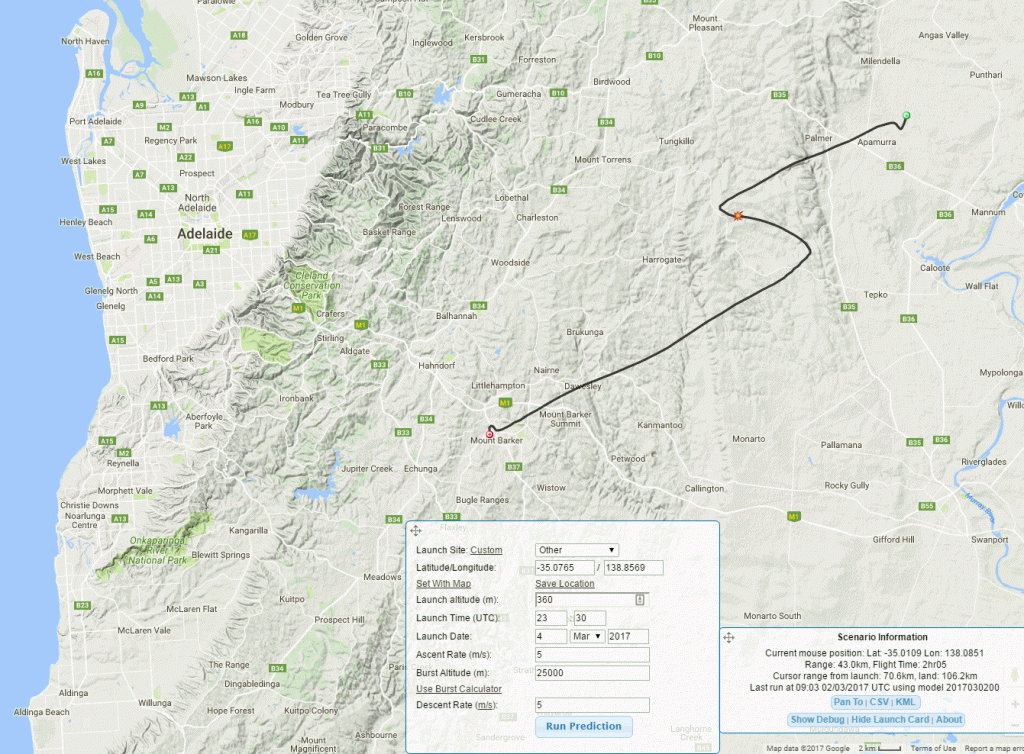
Predicted flight path, as per 2016-09-17 06Z GFS model. (5m/s ascent rate, 3.5m/s descent rate, 34km burst altitude)

Amateur Radio operators across SA and western Victoria as far east as Melbourne should be able to hear the telemetry transmissions on 434.650 MHz using 100 baud RTTY (7N2). If you decode the transmissions using the dl-flDigi program, you can contribute your received frames to the global pool of tracking data enabling us to follow the flight.

You can find a guide to tracking the balloon flight using the dl-fldigi software at the following link: https://ukhas.org.uk/guides:tracking_guide

As usual, the payloads can be tracked live on the Habhub Tracker, available here.

As an added bonus, this flight will be carrying an experimental payload transmitting 115kbaud FSK on 441.200MHz, downlinking live images from the payload. This payload has been in development by David Rowe (VK5DGR) and Mark Jessop (VK5QI) for some time, and utilises an open source modem stack. If all works as expected, images should appear on this page: http://ssdv.habhub.org/VK5QI