Horus 41/42 Flight Report: Southern Hemisphere Space Studies Program Jan 2017

Introduction

For the second year running, the Amateur Radio Experimenters Group was invited to partner with the University of South Australia and the International Space University in delivering the Southern Hemisphere Space Studies Program. This program, which is a 5 week intensive live in course offered by the universities to students from around the world, is designed to meet the needs of:

  • Professionals seeking more knowledge of and contacts in the international space sector

  • Graduate researchers in all fields seeking a broader knowledge of international space activities and the disciplines involved

  • Undergraduate students in the final two years of their studies seeking exposure to the various aspects of space studies to complement their undergraduate studies

* Extracted from the ISU Website
Part of the program comprises a simulated satellite launch campaign using a high altitude helium balloon platform, flown using the resources of the Amateur Radio Experimenters Group and Project Horus, which are based here in Adelaide. This in fact marks the 7th year of the group’s High Altitude Balloon Project, which was the brainchild of Terry Baume VK5VZI.

Like many of the Horus launches, this one again sought to strengthen ties with programs that are related to Science, Technology, Engineering and Maths (STEM) in education. Bringing Amateur Radio into context with space studies and education helps highlight the huge diversity of the Amateur Radio service and it’s absolutely unique place in the Australian technology landscape. No other radio-communications service provides an opportunity for interested persons from a huge diversity of backgrounds to come together and undertake cutting edge explorations into communications technology.

ISU: Project Space Balloon

The project this year was set some very ambitious goals. Built on the success of last year’s flight, and the newly designed high speed transmission link capability designed by Mark VK5QI, with help from David VK5DGR and Bill VK5DSP, the plan this year was to send aloft two balloons simultaneously, carrying look down cameras observing in both the visible and near infrared spectrum. The aim was to conduct investigations into water resources through remote sensing imagery. These payloads were to downlink their data in real time over the Wenet 115kbit/s telemetry links. A third Wenet payload with an outward looking camera was also flown.

The students were then mentored through the construction of the second Wenet payload by Mark VK5QI and Matt VK5ZM. They were also given training in flight prediction, launch and recovery procedures by Matt and Grant VK5GR and were given opportunities to be involved in every aspect of the flights.

Ultimate launch control, tracking and recovery was then the responsibility of the AREG team, with over 20 members involved in some aspect of the flight, as well as many more amateur radio operators across South Australia who all contributed to receiving telemetry information from the balloon, which helped with the payload recovery efforts.


The Launch Campaign: Horus 41 – McLaren Vale

The day began early, with the AREG and University teams arriving at Serafino’s Winery in the picturesque McLaren Vale region at 8.00am. The first order of business was to unpack the balloon filling station, and then setup the Wenet SSDV receive ground station, which was to be used later in the day to capture the 115kbit telemetry from Horus 41 and relay it into the publicity event at the winery. Horus 41 ground was to be manned by Paul VK5BX and Bill VK5DSP (from UniSA), with much of the equipment supplied by Matt VK5ZM.

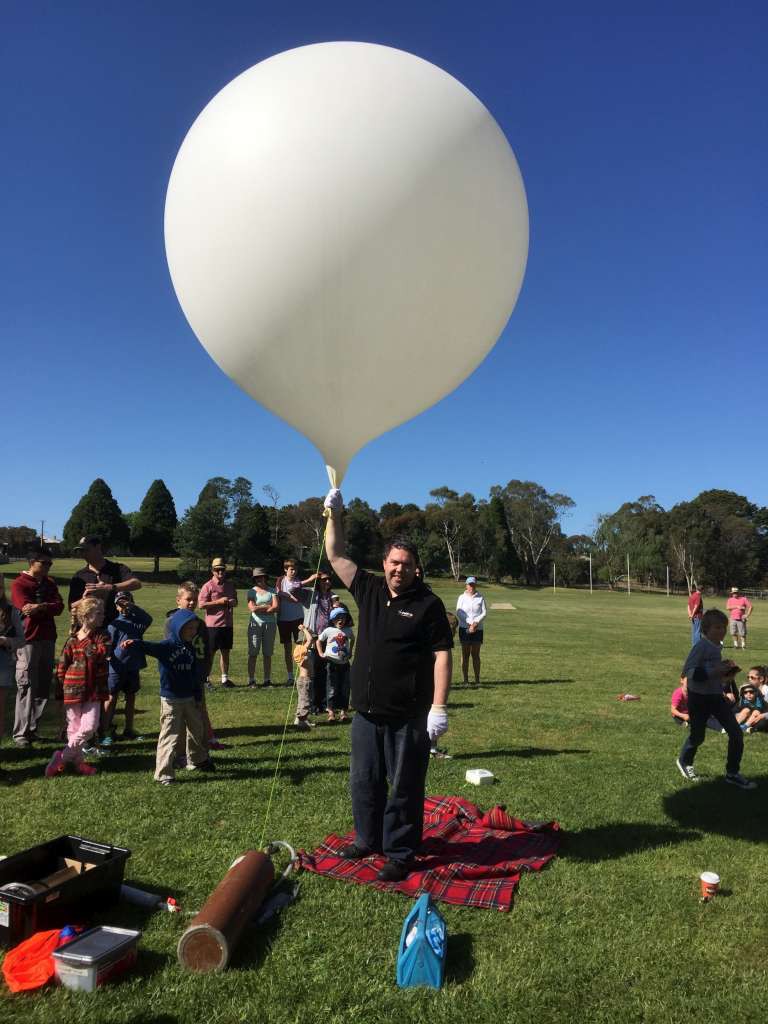
Matt and Chris VK5CP were also heavily involved in the publicity engine throughout the day, with Matt again proving adept as master of ceremonies during the launch, describing to the spectators what was happening and the overall process of getting the balloon in the air. He also played a major role in the formal part of the SHSSP program, giving a formal 10 minute presentation on the AREG, Project Horus and Amateur Radio to 100+ guests and VIPs invited to attend the launch.
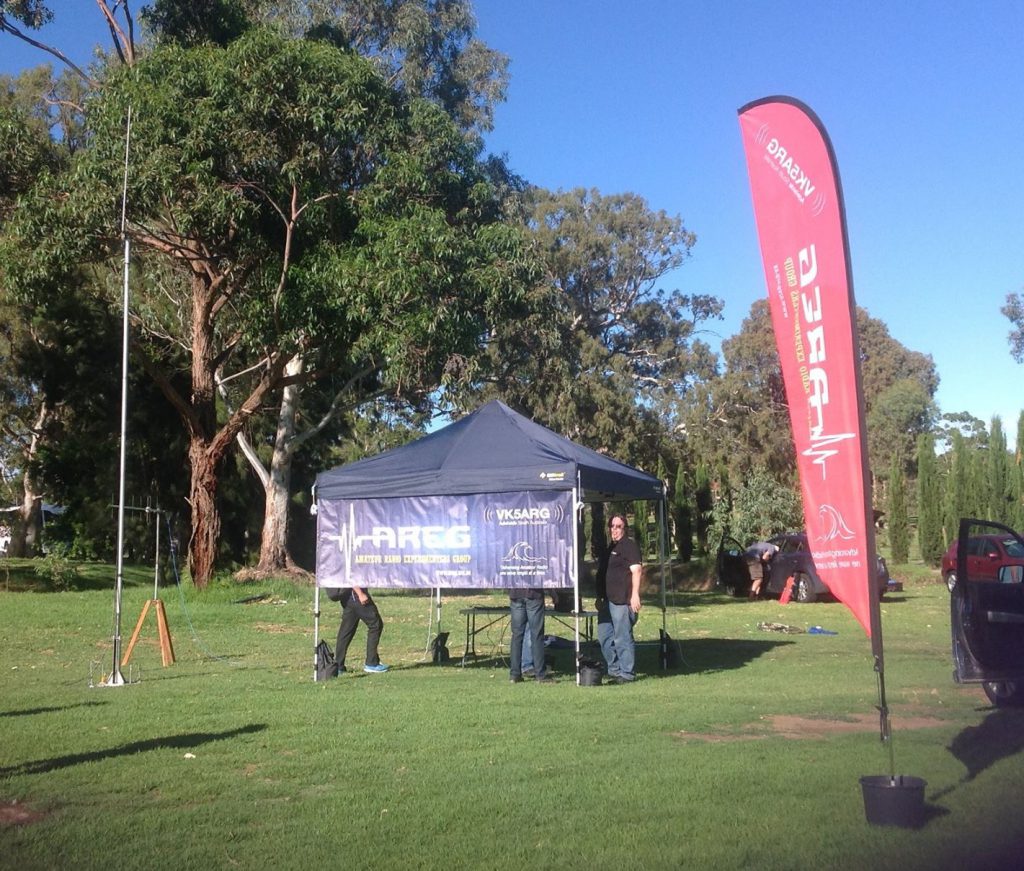
The payloads were then laid out in order and the balloon train was prepared, with students helping the AREG team along the way. Some extra payload was added in the form of Serafino wine grape seeds, which will subsequently be planted to see if exposure to high altitude changes their character at all many years down the track.

Next, balloon filling got underway and the ISU student team set about helping Grant VK5GR, Andrew VK5XFG, Josh VK5JO and Sharon VK5FSAW getting the balloon filled and readied for launch. Horus 41 was to use a Totex balloon and was carrying approximately 1.2kg in payload weight.

The count down began and everyone kept an eye on the time, knowing that the team in Mt Barker were doing the same thing. We aimed to lift off at 10:00am, but due to some difficulties with the balloon filling equipment, this was delayed slightly. The count down went on hold while this was rectified, and then we resumed. By 10:02am everything was ready, and launch release was placed into Matt VK5ZM’s hands.

Contact was then made with Launch Team 2 up in Mt Barker to confirm how their preparations had run.

The Launch Campaign: Horus 42 – Mt Barker

The Mt Barker launch was a more low key affair, with just the ISU students and the AREG launch team. Mark VK5QI lead operations at Mt Barker, helped by Kim VK5FJ, Dennis VK5FDEN, Anthony VK5AHV, David VK5DGR, Andrew VK5AKH and Gary VK5FGRY. Horus 42 was using a larger Hwoyee Balloon as the flight path was predicted to encounter fewer obstacles.

Horus Ground Control Strathalbyn comes Online

An unseen to the public but vitally important part of the exercise was the work being undertaken by Peter VK5KX and Scott VK5TST to provide a primary ground station for collecting the Wenet imagery. Peter found himself a suitable location on the SE edge of the Mt Lofty ranges and setup the communications bus. It served two purposes, with the first being the telemetry reception and internet uplink, but the second was also recovery team liaison on VHF amateur radio (2m). Repeater coverage in the landing zone was very poor, so simplex relays were used to maintain team communications.

Liftoff for SHSP 2017 – Tracking begins

Finally at 23:45UTC (10:15am) both Horus 41 and Horus 42 made it into the air. At the last minute, the ground winds sprung up at Mt Barker, causing some consternation. The launch was held for 2 minutes while the team waited for the winds to abate, and then we took to the skies. Telemetry started to stream in as the balloons gained height and more distant stations could receive the signals. Images were being received too and all looked good for two successful flights.

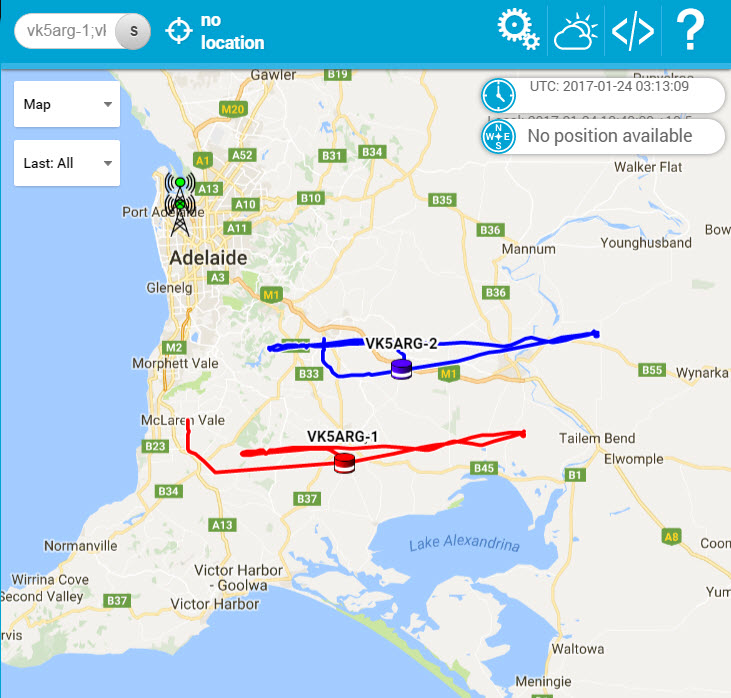
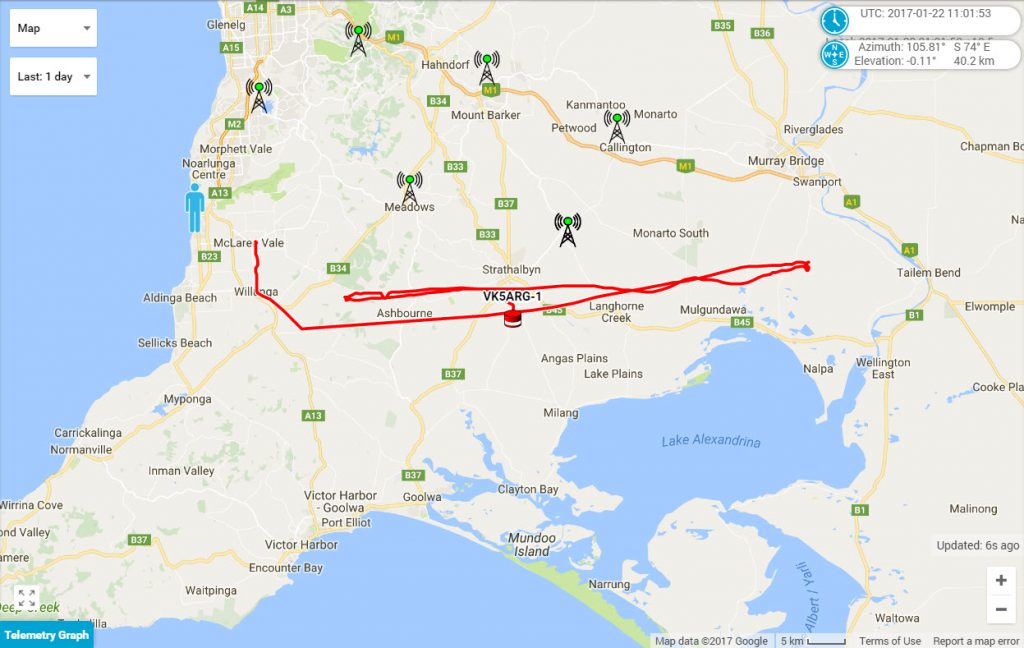
Shortly after lift off, however, the first wrinkle appeared in our plans. High Altitude Ballooning is never an exact science, and today wasnt going to be an exception. It turned out Horus 41 wasnt climbing as fast as intended and the low altitude winds were pushing it further south than planned. This was bad news, as it greatly increased the risk of a landing in Lake Alexandrina (and the consequential loss of the payloads) instead of on the open plain to the north of it.

An anxious hour followed where the predictor was watched very closely, tracking height, and the actual landing zone if the flight was stopped at any particular moment. Fortunately the track drifted north and we started to breath easier, once we passed 31km altitude and had removed the lake from the landing equation.
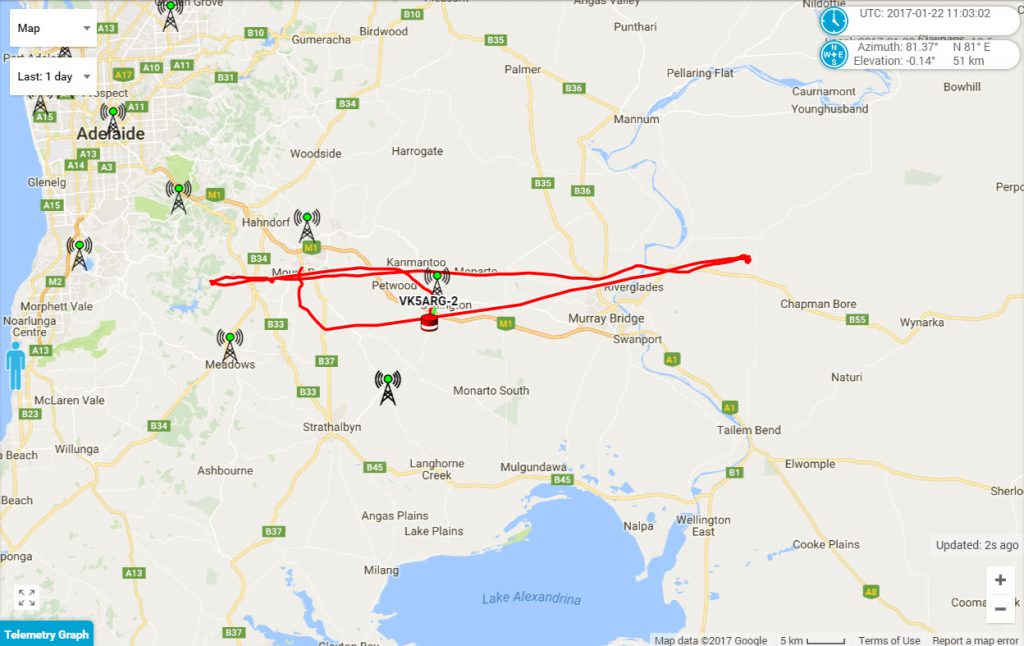
Horus 42 had an easier time, although it too had obstacles to avoid. One of the problems of summertime flying was that the jet stream was quite weak, and so flights don’t travel as far east as the team would prefer. Recovery in the Adelaide hills is never easy due to access and terrain. It’s flight track looked as follows:
This was also one of the most complicated flight campaigns AREG and Project Horus has undertaken. All up we had 2x LoRA transmitters, 2x RTTY transmitters and 3x 115Kbit Wenet transmitters on air on 70cm at the same time! This spectrum display shows how we were spread out across the Amateur 430-450MHz band – where we had to borrow space from the ATV and repeater link segments to accommodate everything.
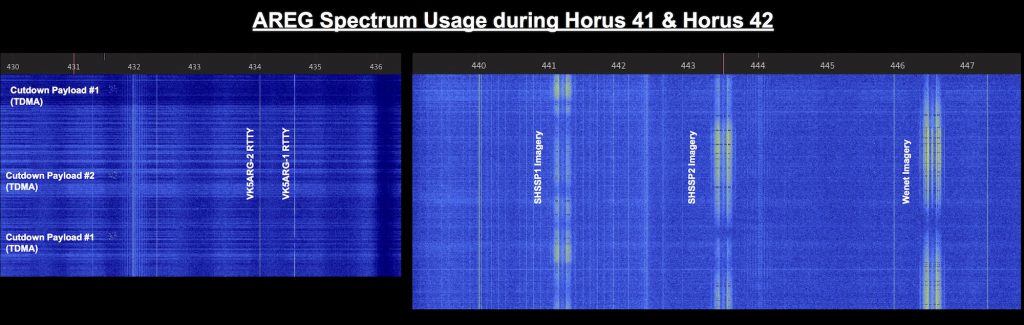
This puts the amount of work into perspective in constructing and operating all of these facilities.

The reception of all of these telemetry feeds was only made possible by the contributions from amateur radio operators across the state. Those recorded in the system has having contributed telemetry frames were:

Horus 41 RTTY – VK5QI-9, VK5ZM, VK5AKK, VK5ZRL, VK5DF, VK5EI2, VK5NEX, VK5KIK, VK5PJ, VK5ZLX, VK5HS, VK5DMC, vk5ftaz, VK5DF/p, VK5EI, VK5KX, VK5DC, VK5FJGM, VK5ALX, VK5RR, VK5EU, VK5PJ/P

Horus 42 RTTY – VK5AKH, VK5AKK, VK5KJP, VK5KIK, VK5ZEA, VK5DC, VK5PJ, VK5KX, VK5RR, VK5DF/p, VK5ALX, VK5DF, VK5DMC, vk5ftaz, VK5HS, VK5ZLX, VK5TST, VK5EU

SHSSP1 SSDV: VK5DSP,VK5ZM,VK5FI

SHSSP2 SSDV: VK5AKH,VK5KX,MI0VIM,VK5RR

The AREG and SHSSP thank you all for your interest in the project and your contributions to the tracking and telemetry effort.

A special thank you too to Phil Heron MI0VIM who was in Australia this week and flew across to Adelaide especially for this event. For those who didn’t realize, Phil is one of the creators of the HabHub system that the UK High Altitude Society built that is used by Project Horus to support our flights.

And then the Images Flooded In…..

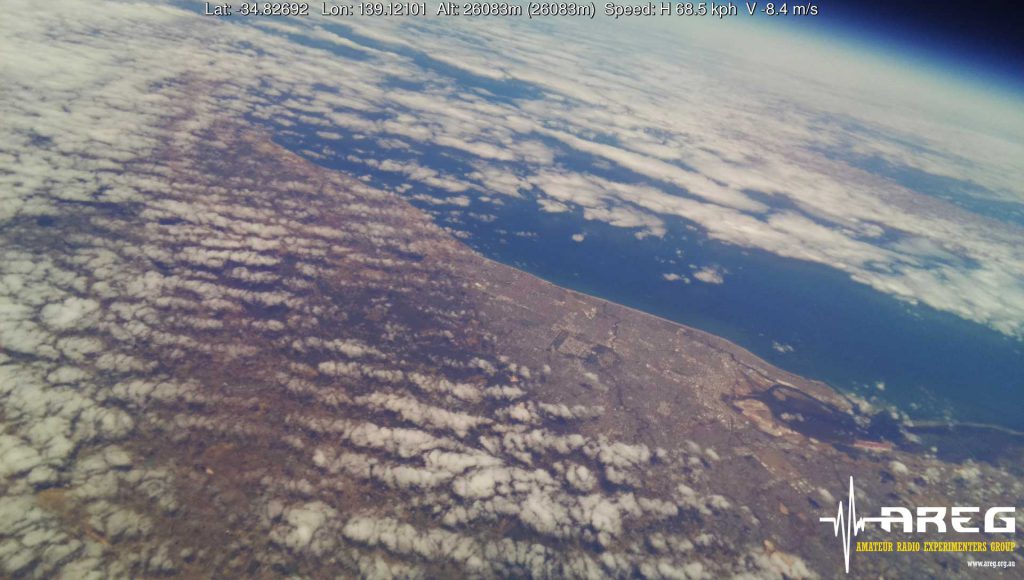
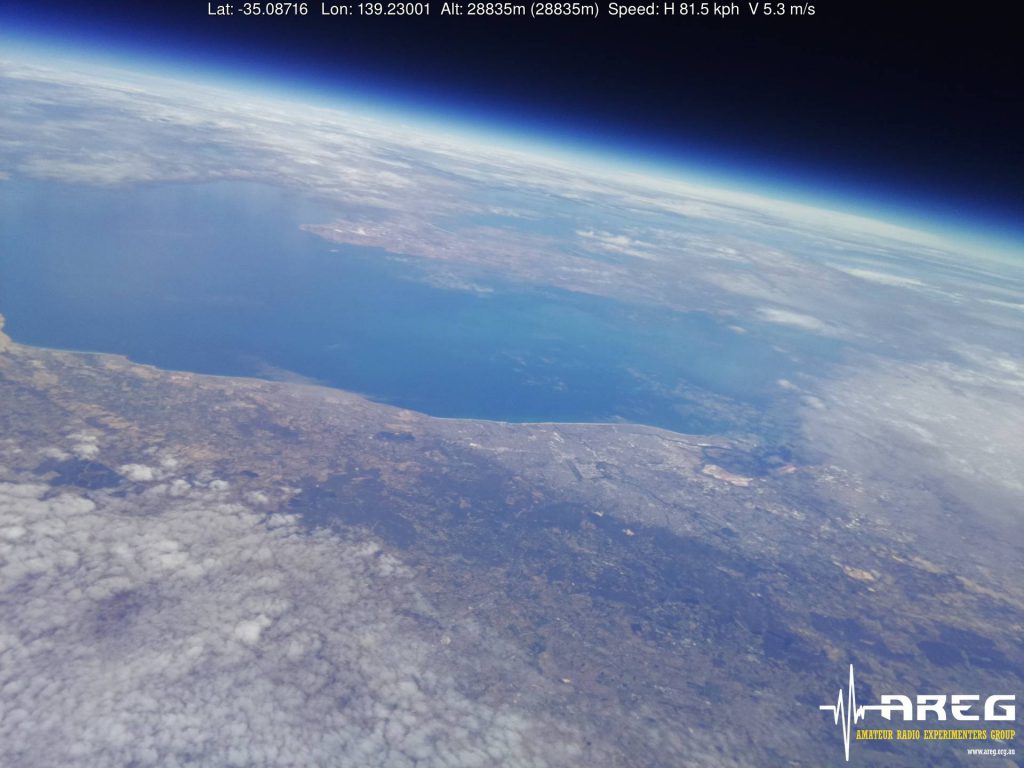
Once the payloads were in the air, the real business got underway. The pictures being retrieved were spectacular:

Horus 42 – Wenet Outward Looking Visible Spectrum

This slideshow requires JavaScript.

Horus 41 – Near InfraRed Images

This slideshow requires JavaScript.

Horus 42 – Near InfraRed Images

This slideshow requires JavaScript.

Recovery – Horus 41

The recovery of Horus 41 was very easy (for a change) with the payload landing on a service track that we could easily get to within 100m by car. Touchdown was ~1km from the tracking team, although we weren’t lucky enough to catch a glimpse of it in the air. After the land-owners were approached, access to retrieve the payloads was obtained. Three of the SHSSP students plus the AREG Horus 41 tracking crew collected the payloads, and then as a surprise for the organizers were able to deliver them back to the launch venue and present them to the VIPs prior to the conclusion of their event.

Recovery – Horus 42

Horus 42’s flight recovery was also successful, although it did come close to landing on a major road! In the case of Horus 42, they were there to see the landing live! No small achievement (only about 1 in 5 flights are we there at the exact landing site).

Flight Statistics – Horus 41

[table “” not found /]

Flight Statistics – Horus 42

[table “” not found /]

Conclusion

All told, the day was considered a complete success. Both balloons achieved greater than 30km altitude, the images were successfully collected over the air on the Wenet network and 23 separate amateur stations across South Australia were involved in collecting tracking information.

The goals of Project Horus’s engagement with the Southern Hemisphere Space Studies Program in bringing Amateur Radio into education were met and then some! It was fantastic again working with the crew at the University of South Australia, and we hope that AREG is again invited back next year!

Keep Watching…

Stay tuned for a further blog post this week with some video animations of the tracking and some film clips of the launch and landing activities too! More to follow…..

Launch Day: Horus 41/42 Tracking Details

Watch here for details of tracking both Horus 41 (VK5ARG-1) and Horus 42 (VK5ARG-2). The links to the Wenet payload images will give you a look at the two look down cameras – one filming in visible light, the other in Infra Red.

Live updates on the flight progress from the chase teams will be available via the club Facebook page www.facebook.com/vk5arg

Flight Times / Locations:

Horus 41 – McLaren Vale – 10:00am ACDT

  • RTTY Telemetry: 434.650MHz 100 bps
  • Wenet Imagery Payload 441.2MHz 115Kbit/s

Horus 42 – Mt Barker – 10:00am ACDT

  • RTTY Telemetry: 434.075MHz 100 bps
  • Wenet Imagery Payload: 443.5MHz 115Kbit/s

Both balloons are intended to be launched simultaneously! Listen on the VK5RSB 70cm repeater for the launch coordination.  Tracking details for RTTY payloads can be found here (click).

For some background on this event take a look here (click).


Introducing the Southern Hemisphere Space Studies Program to Amateur Radio

The Southern Hemisphere Space Studies Program is conducted by the University of South Australia in partnership with the International Space University (ISU).

The program provides a multidisciplinary understanding of the key activities and areas of knowledge required by today’s space professions, including

  • space science and exploration
  • space applications and services
  • human spaceflight and life sciences
  • space systems engineering and technologies
  • space policy and economics
  • space business and project management and
  • space law and regulatory issues

The program is open to Australian and international participants from all disciplines


Who is this Program For?

The Southern Hemisphere Space Studies Program is designed to meet the needs of:

  • Professionals seeking more knowledge of and contacts in the international space sector
  • Graduate researchers in all fields seeking a broader knowledge of international space activities and the disciplines involved
  • Undergraduate students in the final two years of their studies seeking exposure to the various aspects of space studies to complement their undergraduate studies

Project Space Balloon

On Sunday 22nd January, 45 students from 11 nations will come together as part of the International Space University’s Southern Hemisphere Space Studies Program to perform an exciting stratospheric balloon launch experiment. Two simultaneous balloon launches will occur at McLaren Vale and Mt Barker, carrying satellite payloads designed and built by the program participants to an altitude of 35km. The payloads will capture and downlink images of the surrounding area to be watched live from the McLaren Vale launch site. In addition, a packet of Serafino grape seeds will be carried on each balloon for the flight. These “Space Seeds” are then to be planted at the Serafino winery. Also, over the next 5 days a competition to name the payloads will be run, with the winner receiving a mission patch flown into space on the balloon.


Amateur Radio Supporting STEM Education through SHSSP

The Amateur Radio Experimenters Group, comprising members of the general public who have interests in radio communications technologies and techniques, is a major supporter of the SHSSP program at UniSA. Members of AREG come from all walks of life, from plumbers to senior telecommunications and manufacturing engineers, electronics technicians to lawyers, couriers to fitters and turners. All are bound by their love of radio and what you can do with it, which has driven them to undertake the self training and education required to be licensed to operate transmitters within the international Amateur Radio Service.

Amateur Radio is a key activity within the Australian community where educational opportunities exist to enhance knowledge of Science, Technology, Engineering and Maths (STEM). Bringing Amateur Radio to the Southern Hemisphere Space Studies Program and showing how it can form an integral part of such a significant activity clearly demonstrates the relationship between the Amateur Radio service and education. It reinforces the importance of the Amateur Radio service to the country.

AREG and the Amateur Service’s Contribution to Project Space Balloon

For this launch campaign, over 20+ members of AREG will be acting in support roles providing tracking and recovery teams, data collection teams, payload & communications systems design and launch services. The balloon payloads themselves will be connected to the ground via radio links provided via spectrum assigned to the Amateur Radio Service. Further,  as many as 50 more radio amateurs located across SE Australia will be engaged with telemetry collection in support of the flight, including some from as far away as Melbourne, Victoria (800+ km away).

AREG’s history in High Altitude Ballooning is also a long one. Members of the group have been active in High Altitude Ballooning since 2009, and with over 40 launches to their credit, significant expertise in the area has been developed. It has been one of the most active groups in this field in the last decade in Australia. All of this has been happening within the context of a self funded group of experimenters and explorers.

It is with that background that we are able to support this program. We are very pleased to be able to bring that experience back to the community and to be able to contribute to such a worthwhile venture.

Horus 41/42 Balloon Flights – Sunday 22nd Jan – Frequencies

 The Amateur Radio Experimenters Group is pleased to announce that it has been invited back to participate in the International Space University’s Southern Hemisphere Space Studies Program (SHSSP) for 2017.

This year, the club will be extremely busy with plans to simultaneously launch two balloons from two launch
sites. This means double the number of payloads to track and double the fun for the launch and tracking teams as well!


Flight Times / Locations:

Horus 41 – McLaren Vale – 10:00am ACDT

  • RTTY Telemetry: 434.650MHz 100 bps
  • Wenet Imagery Payload 441.2MHz 115Kbit/s

Horus 42 – Mt Barker – 10:00am ACDT

  • RTTY Telemetry: 434.075MHz 100 bps
  • Wenet Imagery Payload: 443.5MHz 115Kbit/s

Both balloons are intended to be launched simultaneously! Listen on the VK5RSB 70cm repeater for the launch coordination.  Tracking details for RTTY payloads can be found here (click).

[wpgmza id=”12″]

Launch Site Map


Image from Horus 40 – sample of whats to come for Horus 41/42

Payload Information

The university project this year is using the Wenet payload designed by Mark VK5QI to accommodate 2 cameras taking alternate photographs, both facing downwards. One will be shooting in the visible light spectrum while the other will be photographing the IR spectrum. Additional telemetry is now being included also, with an Inertial Measurement Unit on board giving payload orientation data. The hope is to combine the data from both balloons into a stereoscopic representation of the terrain and vegetation below.

All of the images are being collected live and will be available via the Internet (watch this page for details closer to the day).


How to get involved?

Visitors are welcome at the launch sites on Sunday morning. AREG members are encouraged to dress in their club apparel as there will (hopefully) be lots of media around, at least at the McLaren Vale launch site at Serafino’s Winery.

You can get involved in tracking the flights from home. The more stations involved, the better! We will have our hands full with two balloons in the air so help from ground stations collecting telemetry and forwarding it to the Internet for us.

For the adventurous, you may also like to get involved in receiving the Wenet transmissions and receiving the pictures directly! All you need is a Linux based PC running Ubuntu 16.04 RX, an RTL-SDR Dongle, a preamplifier (because the RTL-SDR needs all the help it can get) and a suitable UHF 70cm antenna.

Details of the receive system are given on Mark VK5QI’s GitHub page: https://github.com/projecthorus/wenet


If you would like more information, contact the president, Matt VK5ZM@wia.org.au

More news as the launch gets closer and details are confirmed. We wont know with reasonable certainty that we are flying until ~48hrs before liftoff.

Next Meeting: 20th Jan – Radio Beginner Series: The art of QSLing

During 2017, the AREG is planning a set of presentations to be known as the “Radio Beginner Series”. The intention is that every 4 months, the evening will be dedicated to something simple, but which any beginner starting out may not have been exposed to before. Ideal for foundation licensees, but also equally applicable to old hands trying out a new aspect of the hobby that they haven’t engaged with before.

The Art of QSL Cards and Confirmations

This month, the topic of sending and receiving QSL cards will be introduced, including all of the ways that you can achieve confirmation of your contacts, particularly if you are chasing awards. The talk will cover things like:

  • QSL card design – what to put on your cards
  • Ways of sending physical cards
    • Bureau
    • Direct – IRCs and “Green Stamps”
    • via QSL Managers
  • How to get electronic confirmation
    • ARRL’s Logbook of the World
    • eQSL.cc
    • ClubLog Log Matching & OQRS QSL Request Services
  • How do you manage Multiple Logs on these services?

The doors will open at 7.45pm, with meeting starting at 8.00pm. After the main presentation, tea coffee and supper is available followed by a general meeting. Hope to see you there!

[wpgmza id=”5″]

Horus 40 Flight Report: January 2nd 2017

On Monday January 2nd 2017, the Amateur Radio Experimenters Group launched a test flight of some new telemetry equipment, and trialed the updated Wenet SSDV system being developed by the group. The aim was to validate some new software ready for a dual flight being planned for January 22nd for the Southern Hemisphere Space Studies Program (SHSSP) run by the University of South Australia.

Launch Preparations

The payloads being flown this flight included:

  • RTTY Telemetry (434.650 MHz 8N1 ASCII 100baud) – The usual RTTY payload as has flown in the past.
  • Flight Control payload (TDMA) – we use this for telecommand to terminate the flight at the right altitude
  • Secondary Test Flight Control Payload (TDMA) – In-air test of new TDMA software updates.
  • Wenet Imagery Payload – 441.200 MHz 115Kbit/s Wideband FSK
  • GoPro HD Hero 3 Video Payload – 25fps 1080p video – to be collected after landing

Wenet had been upgraded this flight to send back 1920×1080 frames and include on each frame some telemetry information too!

Balloon Launch Crew

On the ground, we had a large contingent of members from the Project Horus team. Matt VK5ZM lead the assembly of the balloon payload train while Mark VK5QI tended to the payloads. Grant VK5GR, Josh VK5JO, Gary VK5FGRY and Andrew VK5XFG set about filling the balloon.

Liftoff went flawlessly, which meant the chase and tracking was next.

Flight Ground Tracking Network

As in Flight 39, Peter VK5KX and crew stationed themselves on top of a hill over looking Palmer in the Adelaide Hills. From there, he was able to receive much of the data from the Wenet transmitter carrying the SSDV data.

When the balloon reached 15km altitude and was almost directly overhead, he also reported that using a telescope he was able to get a visual lock on the balloon for a time!

Bob VK5FO and Ray VK5RR operated ground control No.2 from their home near Waikerie in the Riverland. Bob reported:

“We were really trying to run several experiments on our rx capability and do a bit of a shakedown before the Dual launch. Some things worked, some things failed – but we have a much better insight into what is needed.

First off the Good.

Wenet – both of our Wenet RX set ups worked great – well, WinSDR, Pre-Amp and Laptop with software.  We again used a dual-band white stick antenna – so about 8db gain on 70cm.  We were able to RX images from 1,800M up to 25,000M and then from 25,000 back down to just 900M!  Abovr 25,000M we did see some data, but not reliable at all.

Our 2nd Antenna – we used for experimenting with was nothing more than a mobile dual band whip – and we may as well have not bothered from this distance – 4.5db gain does not cut it.

This is very similar to what we experienced the previous flight – but this flight was much closer to us – about 90km v’s the 120-130km of the last one and as a result we had rock-solid +10db WENET signals for most of the flight – except when it was very close to the ground and again once it flew out of the antenna pattern over 25,000M

Except during the extremes, we had almost 100% decode on all images – well over 100Meg of images in the images directory!

…and then the not so good…

We had a lot of trouble even hearing the RTTY telemetry – and it was not until it was about 6,000M that we even heard it!  We used our usual set up – of the IC-7100 in the car with a dual-band mobile whip to RX – and this is what we have used in the past without issue – Not so much of an Issue – except that it provides useful information WRT the Az and El of the balloon from your location – which might be needed – especially to be able to track the Payload with a directional array.

I suspect that we were had the car parked behind the shed and it was causing us to sit in the shadow of the flight until it hit the 6,000M mark.  This is something easily rectified on the next flight – move the car or put the antenna on the shed roof!

As usual, the RTTY should be able to be decoded by anyone within about 100km with a fairly simple antenna, further with a little bit of gain.

So, while not everything was perfect, we were very happy with the resultant WENET Images we received.”

Flight Data

The end result of all of the ground station work was that the Wenet SSDV image payload worked a treat, Here is a slideshow of the pictures captured:

This slideshow requires JavaScript.

In addition, a GoPro was flown on the flight. The payload container this time suffered from some stability issues and so the images are not fantastic quality, but we did get some excellent frames out of the video at the time of balloon separation due to the tumbling. A number of selfies were taken of the other payloads and the parachute just as decent began. Check out the video here:

Flight Statistics

The flight itself was almost a text book affair. The flight track can be seen in the following animation created by Grant VK5GR from the telemetry raw data.

The vital statistics are:

[table “” not found /]


The final flight tracks can be seen here:

Maps from in car trackers

maps from HabHub.org

Chase & Telemetry Teams

The chase tracking for this flight was carried out by three teams this flight. Matt VK5ZM formed a team with Grant VK5GR, Josh VK5JO and Andrew VK5XFG, Andy VK5AKH had a team with Will Anthony VK5AHV, Darin VK5IX and his son Cam, and Mark VK5QI had a team with David VK5DGR and Gary VK5FGRY.

The chase teams in particular were using this flight to also get ready for the big dual flight planned on January 22nd.

The team would like to thank all of the following stations for their contribution to the  telemetry collection effort:

VK5AKK VK5DF VK5EU VK5FTAZ VK5KJP VK5KX VK5NEX VK5NG VK5QI-1 VK5QI-9 VK5RR VK5ZEA VK5ZM VK5ZRL

Recovering Horus 40

The team had always planned on terminating the flight early as trying to recover the payloads in the Adelaide Hills, particularly the fairly remote eastern side is never easy. There were a number of tense minutes when the trigger mechanism appeared not to work, causing the balloon to fly further east than planned. Our worst nightmares looked like they were then going to materialize with a landing targeting the mountain goat country on the back of the escarpment. Fortunately, the payloads landed in a relatively accessible location, not far from an access road. A short hike up a hill and everything was found intact laid out before us awaiting collection.


Conclusion

Everyone declared Horus 40 a success, despite the issues with the delayed flight termination. Some fantastic images were obtained of Adelaide from 26km altitude, encouraging the team to continue to fly the SSDV payloads and enhance the ground station tracking systems. (More on that to follow).

Regards, The Project Horus team

Horus 39: December 3rd 2016 Flight Report

logottgc


On Saturday December 3rd 2016, the Amateur Radio Experimenters Group launched the Tea Tree Gully Library mascot, Anstey the Echidna into the stratosphere as part of her next big adventure. In the past 12 months Anstey the Echidna has been to France, Italy, Ireland, Japan and New Zealand.

Flying an Echidna into near space is not without its challenges. It took a very large team of people from the Project Horus group within AREG, as well as a large number of amateur radio operators from across SE Australia to achieve this feat.

Launch Preparations

The first stage of the journey was to build the craft that would carry Anstey into the stratosphere. Mark VK5QI and Matt VK5ZM worked some long hours preparing the vehicle to make sure that not only would Anstey get a perfect view, but that those of us on the ground could also share her experience.

The cameras used included a GoPro Hero 3 and a Raspberry PiCam connected to the Wenet 115kBit/s 50mW data transmitter. This was only the second full flight of the Wenet system which has been co-developed by Mark VK5QI and David VK5DGR using an FSK modem developed by the team with help from Bill VK5DSP. (more on this shortly).

Balloon Launch Crew

On the ground, we had a large contingent of members from the Project Horus team. Matt VK5ZM lead the assembly of the balloon payload train while Mark VK5QI, Grant VK5GR, Kim VK5FJ and Gary VK5FGRY set about filling the balloon.

After the “Balloon meets tree” incident during Horus 38, we added an extra safety measure, with the release of a sounding balloon before the main launch.Grant VK5GR’s daughter, Amelia, did the honors.

Finally, the team from the Tea Tree Gully council started their Facebook live broadcast back to mission control and we prepared to send Anstey off into the sky on her epic journey.

Mission Control – Tea Tree Gully Library

Back at the library the staff had setup vk5bb-library“mission control” for the morning. Ben VK5BB and Olga VK5FOLG from AREG represented our club at the library and introduced themselves to David Brooks who organised the event. Ben goes on to report:

“David then performed the introductions, giving a little bit of history of the Tea Tree Gully area and how he believes that the local population growth was tied to events within both the USA and USSR space programs. In the back ground we were watching a number of video clips from the Launch site, looking at the equipment, Matt explaining what all the equipment in his vehicle was for, Mark explaining the tracking facilities in his car and the reporter doing his bit at launch time. 

David then introduced  Dr. Brent Gooden who was an expert in a number of fields, space suits, space medicine and Echidnas! He talked about how the Echidna was very well adapted physiologically wise to be able to take the rigors of space travel, all tongue in cheek but very well presented. Mean while on the wall behind the speakers, the images of Anstey were being displayed as they downloaded. Very nicely done!

Then I was invited to the rostrum to give a plug for AREG. I spent about 5 minutes talking about the history of AREG, Project Horus, that AREG was a “young” club and have a focus on radio technology and encouraging young people to look at STEM in their education which was well received.

I was well thanked by David and he publicly acknowledged that without AREG and Project Horus, this event would not have happened.”

Flight Ground Tracking Network

The next major component of the event was the flight ground tracking network. To retrieve the transmitted images from the balloon, we had positioned several stations around the state equipped with RTL-SDR dongles, pre-amps and the receiving software designed to collect the Wenet 115kBit/s telemetry stream. Station No.1 was Peter VK5KX and his partner Wendy, who camped on top of a hill overlooking Palmer on the eastern face of the Adelaide Hills.

tracking-data-recovery-centre-vk5kx

Ground Control Palmer – VK5KX

vk5kx-tracking-central

Ground control inside VK5KX

Peter reports “Wendy & I drove up to Palmer Saturday morning. We had to do some extra km’s due to chain of ponds road being closed, however we got there and rushed the setup completing everything in a nick of time. We were getting SSDV images before we had a lock on the balloon RTTY payload.

just_before_landing-mediumPointing the 5 element 70cm beam at a point in space to Rx the SSDV images was no easy task. I tried using a compass app on the phone, even a Theodolite app, but they were both giving erroneous readings, so I reverted back to a handheld magnetic compass. I did mange to get used to it and made a few notes as to where to point the beam and at what angle of elevation.  Some perfect images were decoded and uploaded.

After the balloon burst, we manageburst_and_parachute-mediumd to track it for some time before starting to have some issues decoding the RTTY. I could see the data clearly but the fl-digi window stayed red, only occasionally going green. To be investigated later. We went on to camp on the hill that night in preparation for Horus 40 on Sunday morning.

When Sunday arrived, the weather appeared with a vengeance. The winds
were so fierce that they nearly blew us away. It did managed to blow some seats and gear down the hill. Unfortunately in it’s path was the beam antenna on it’s tripod. I now need to do some maintenance on the beam.  I notified the Sunday launch crew that we were pulling the plug and then the fun began as we tried to expediently get all the gear in the bus somewhere. Then the rain started too, as I ventured 2/3 the way down the hill to retrieve a red plastic box, the trip back to the bus against the wind & uphill wasn’t pleasant…..”

Bob VK5FO and Ray VK5RR operated ground control No.2 from their home near Waikerie in the Riverland. Bob reported:

“at the last minute before the Launch, we were able to borrow an RTL-SDR and Pre-Amp in order to set up an additional station to RX the SSDV pictures from the Balloon. The RX station was set up in the Riverland, near Waikerie and was reporting Telemetry and Image data as VK5RR.

20161202-141417z-medium 36km_altitude_pic-medium

Given that the site was about 100km+ away from the flight path, it was actually an unknown if it would even RX any data. We monitored the flight data and once the Balloon hit around 6,000M we started to RX some telemetry. It was noted that once the signal got to around 6 or 7db above the noise floor it was getting consistent decodes.

Now, the Antenna used was not ideal – it is a typical “white stick 2/70 Dual band antenna, around 25M of RG-213 before the Pre-Amp. Once we were getting good decodes the RX site was left  unattended for the rest of the flight. We contributed to the image data on SSDV.habhub.org and noticed that at around the 27,000m mark  we lost RX of the image signal.  This was probably a null in the Antenna – given that this was probably around the 25 Degrees elevation from the RX location.

After the Balloon burst, we again started to RX Image data, and this time it was right down to approx 2,000M (at over 140km away).

On checking the recorded images, we had partial data on several, and nearly 100% of others.  A total of 127 Images (complete and partial) were received, and a total of 253 images of the flight were recorded and uploaded.  The RX site provided image data for around 1/2 of the images of this flight.”

We also had Kim VK5FJ receiving the balloon from Mt Barker as well as the two mobile recovery vehicles with VK5QI and VK5ZM, all who contributed some data to the successful images relayed back to Mission Control live from the balloon.

The following animation is compiled from the still images collected from the balloon SSDV telemetry system.

More details about the Wenet system designed by the Horus team and the SSDV platform provided by UKHAS and Phil Heron can be found elsewhere on the AREG site.

Flight Statistics

The flight itself was almost a text book affair. The flight track can be seen in the following animation created by Grant VK5GR from the telemetry raw data.

The vital statistics are:

[table “” not found /]

The team would like to thank all of the following stations for their contribution to the  telemetry collection effort:

VK5APR, VK5EU, VK5FTAZ, VK5KJP, VK5KX, VK5NEX, VK5PJ, VK5QI, VK5RR, VK5ZEA, VK5ZM

Recovering Anstey – in a field of Triticale

burst-mediumThe final act was for the balloon to burst and for Anstey to return to earth to tell her tale. The mobile tracking crews, based on the available predictions, had headed for Lameroo in the Murray Mallee about 250km east of Adelaide. Once the balloon burst however, we discovered that it was falling faster than predicted.

We determined that again the burst hadn’t been a clean one (confirmed with one of the SSDV images we collected) and along with the payloads, a large chunk of the balloon was coming back still attached! The drag of the parachute slowed the descent, but not as slow as originally planned, with the payloads eventually returning to earth at ~9m/s. This caused something of a scramble among the tracking teams as the landing suddenly looked to be about 30km short of where we expected. Fortunately, we weren’t that far away when it touched down, and a good fix from the beacons was obtained before the landing.

After about 20 minutes, we had located the land owners, who were curious to see what we had landed on their property. They were very helpful and friendly farmers who lead us to the landing site in our vehicles. We should have been able to drive right to the payload, except at the critical moment, the telemetry computer crashed in the VK5ZM chase car. So, out with the yagi and direction finding gear to find Anstey the old fashioned way.

After a further 15 minutes, and a hike across a 1m high crop paddock, Anstey was found safe and well.

Conclusion

Everyone declared Horus 39 a success, and looking at the comments and feedback received via social media, it would appear it was very well received by the amateur radio community across Australia as well. We are looking forward to the next time we can fly and hope you will come on the journey too! 73 de Project Horus, Adelaide!

HORUS 40 Balloon Flight: Sunday 4th Dec – CANCELLED

horus-logo-blackThe flight planned for today had to be cancelled at the last minute due to the weather conditions at the launch site. Heavy rain and high winds just as we were to start filling the balloon forced us to call a halt to the proceedings.

The planned flight will now be rescheduled for the first few weeks back at school in the new year (first week of February is being considered)..


It is a very busy weekend for the Project Horus team within the Amateur Radio Experimenters Group. Yesterday (Saturday) we flew a payload for Tea Tree Gully Council Library. Today (Sunday) we are flying a STEM (Science, Technology, Engineering & Mathematics) payload through LaunchBox for a local Adelaide high school.

The predicted flight track for Horus 40 is below.

flight-track-satnight

The parameters being considered for this flight will make it a fast one, as we are aiming to prevent it landing in the inaccessible territory at the western end of Ngarkat Conservation Park, plus we have some less than favorable surface launch conditions to deal with in the morning according to the Bureau of Meteorology.

Horus 40 Flight Details

Liftoff is planned for 10AM ACDT from Mt Barker High School. The payloads will be:

  • Standard RTTY Telemetry: 434.650 MHz, 100 baud ASCII-7N1
  • Wenet Imagery Payload: 441.200 MHz
  • LaunchBox payload
  • Flight Path Management and Control Payload

Tracking will be available via habhub.org habhublogo

SSDV imagery will be available via ssdv.habhub.org/VK5QI

How can you get involved?

Amateurs across SE Australia can contribute to the flight through RTTY telemetry data collection and forwarding to the Internet. Multiple members of AREG are also involved collecting the SSDV imagery data from the 115kbit/s high speed downlink. Follow the links from HabHub or on the AREG website for more details.