Horus 47: Set to Fly on Sunday 4th Feb for SHSSP!

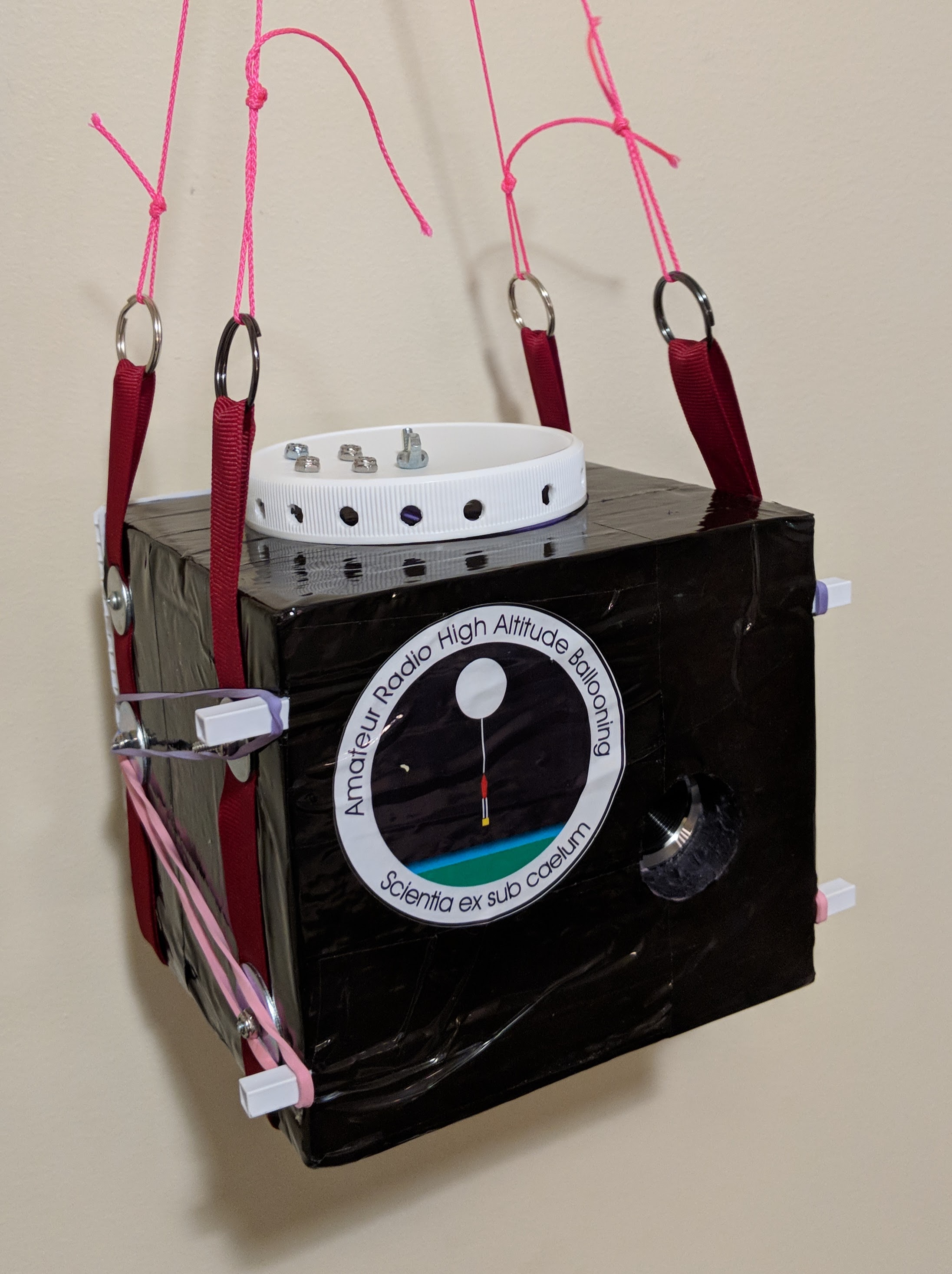
After the successful Southern Hemisphere Space Studies Program publicity flight last week, we are now planning to fly the Science flight this coming Sunday. This flight has two main experiments on it, the first being a Spectrometer which will collect atmospheric composition data for the university and the second is a downward facing camera with a 9DOF inertial measurement unit which is going to be used to create stitched together images from the flight area.

The flight will lift off at 10:00am ACDT on the 4th of February from Younghusband in the Murray Mallee ~150km east of Adelaide.

UPDATE 2018-02-05: This launch has been performed and was recovered successfully – a full writeup is incoming… 

Payload Telemetry Details

As always amateur radio operators from across central and SE Australia are encouraged to get involved with telemetry reception and forwarding to the central habhub.org database.

There are two camera payloads as well as the RTTY and telecommand systems planned for this flight.

  • Primary:      434.650MHz RTTY 100 baud 8N1
  • SHSSP-1:   441.2MHz FSK 115k2 baud Wenet (downward facing camera)
  • VK5ARG:    443.5MHz FSK 115k2 baud Wenet (outward facing camera)

Information on how to receive, decode and relay the information is available as follows:

RTTY Payload

The auto-configure feature within dl-fldigi will automatically configure these settings for you once you pick the correct flight (“Horus 47 / SHSSP 2018 MkII”). The UKHAS tracking guide provides the information you need to set up a RTTY receiver:   https://ukhas.org.uk/guides:tracking_guide

WENET Picture Payloads

Information on setting up to receive the Wenet imaging payload is available here: https://github.com/projecthorus/wenet/wiki/Wenet-RX-Instructions-(Ubuntu-Debian)

Note that this is a few orders of magnitude more complicated than setting up for RTTY, and requires a machine running a recent version of Ubuntu, some Linux experience, and a RTLSDR+Preamp. You also need to be within 100-150km of the balloon to receive sufficient signal.  If you have a WENET capable ground station please concentrate on the 441.2MHz downlink to maximise the data we collect for the university.
Tracking and Viewing Information

If you want to follow the progress of the flights, you can visit www.habhub.org and access the live tracking information as events unfold. You can also access the live SSDV images  from ssdv.habhub.org/VK5ARG

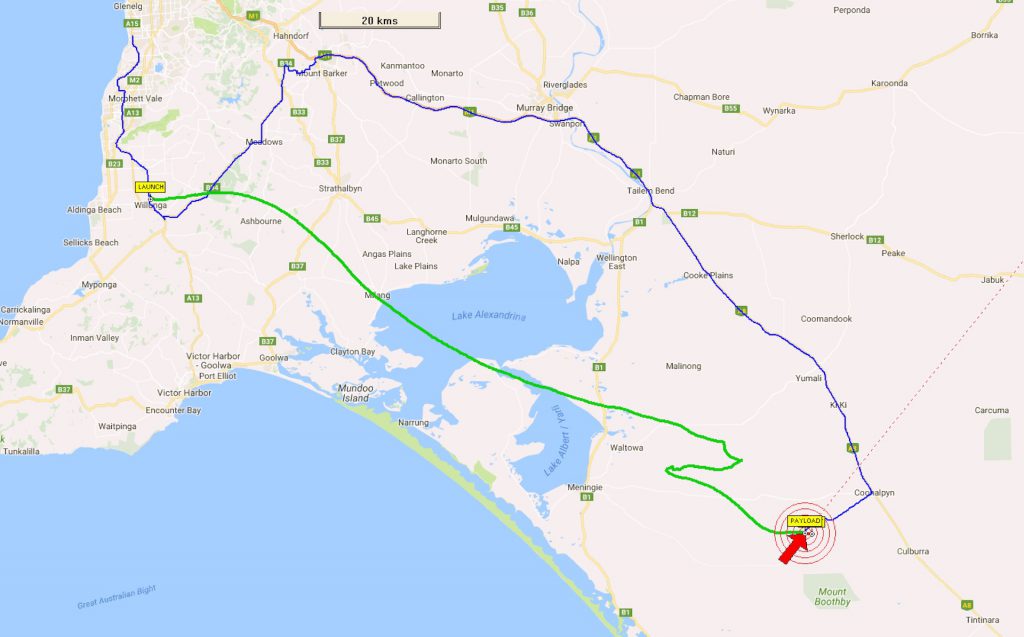
The predicted flight path at this time is:
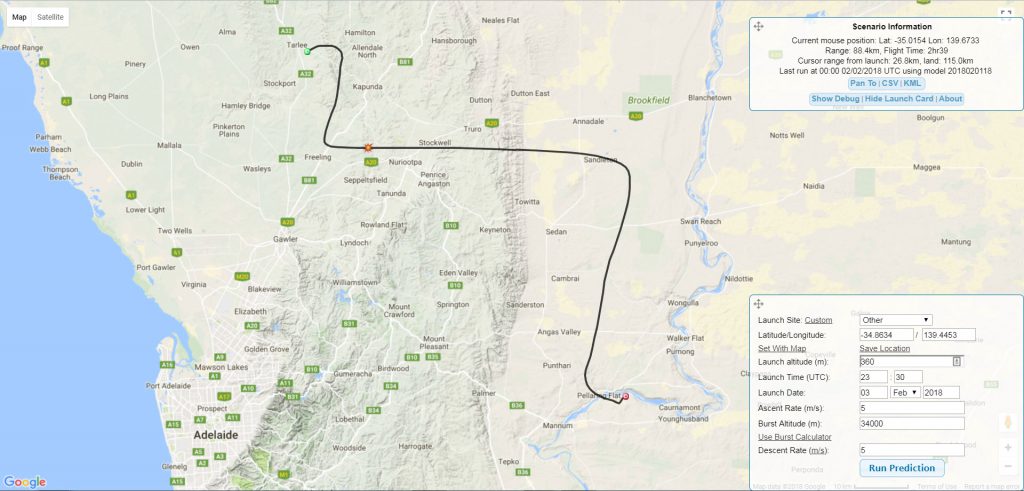
Keep watching the AREG Website for details as things can always change the closer we get to lift off.

Horus 46: International Space University – Jan 2018

The Amateur Radio Experimenters Group teamed up again this year with the International Space University’s Southern Hemisphere Space Studies Program to simulate a space mission using Helium fueled high altitude balloons.
The Southern Hemisphere Space Studies Program is an intensive, five week, live-in experience built around an international, intercultural, and interdisciplinary (3 “I”s) educational philosophy for which the International Space University (ISU) is renowned. The program provides a multidisciplinary understanding of the key activities and areas of knowledge required by today’s space professions, including:

• Space science and exploration
• Space applications and services
• Human spaceflight and life sciences
• Space systems engineering and technologies
• Space policy and economics
• Space business and project management and
• Space law and regulatory issues

The Balloon Mission – 2018

The original plan was to fly a multi-faceted ‘heavy’ mission that included downward as well as outward facing cameras, inertial measurement units reporting the camera orientation (so that the photos could be plotted and stitched together after the flight) and a spectrometer studying atmospheric gas makeup.

Unfortunately the weather was not cooperating, with flight paths landing in severe bush-fire rating zones within the Adelaide Hills, a risk the AREG team were not willing to take. So, at the 11th hour, the plan was re-cast to collect only outward images, without the flight termination devices on board, using disposable payloads. Thus, Horus 46 was born and flew on the 28th of January.

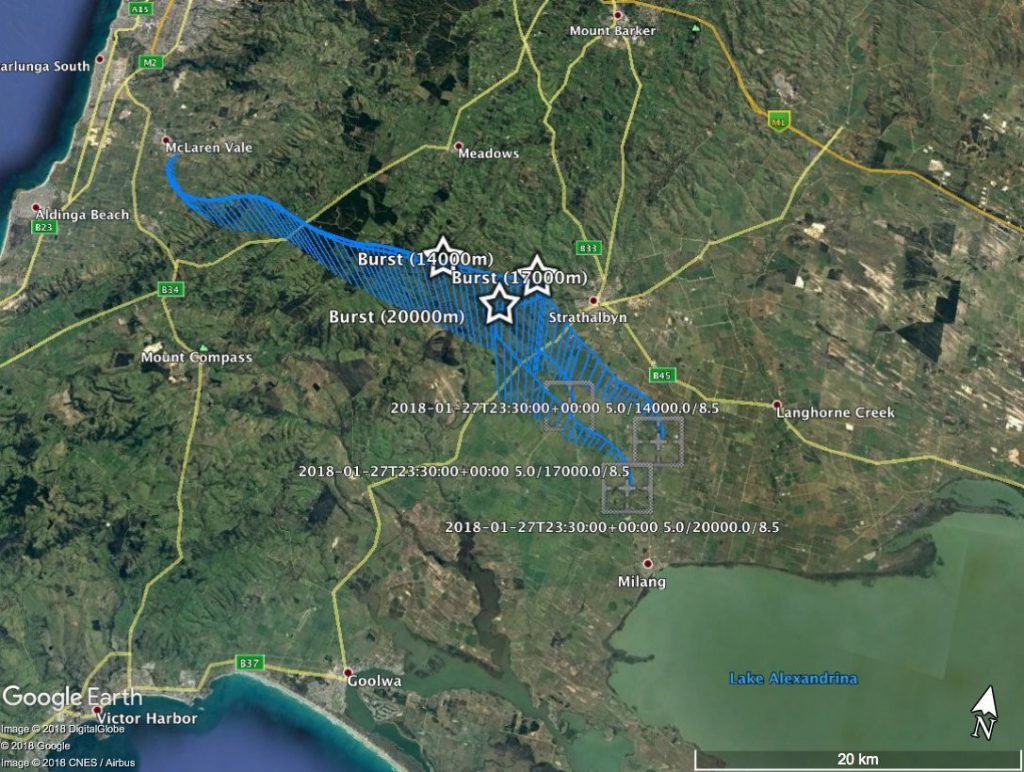
Predicted Flight track before launch

The Launch


(Video provided by Timothy Ryan @AstroTimOz)

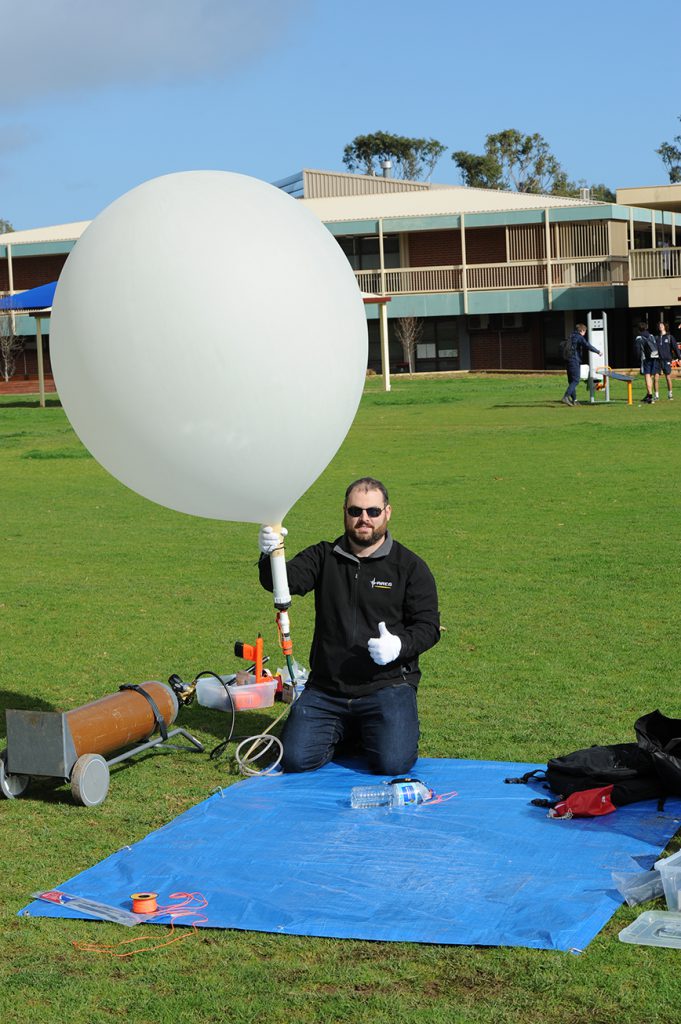
The launch teams arrived at Serefino WInery at 8.00am and by 8:10am we had selected the launch and tracking sites. This year, due to the very calm ground winds we were able to lift off from the front lawns. The SHSSP students then helped with preparing the flight and filling the balloon. Grant VK5GR led the filling operations, aided by Josh VK5JO and WIll VK5AHV  while Mark VK5QI tended to the payloads, Peter VK5KX and Bill VK5DSP tended to the ground station receivers and Matt VK5ZM (club president) secured the balloon train and handled the publicity aspects of the event for AREG.

Telemetry and Images

Telemetry collection was vitally important for this flight as it represented about the only way that we were getting pictures back from the balloon. To this end, we again enlisted the help of Peter VK5KX and Bill VK5DSP who provided the primary image downlink stations for the day.

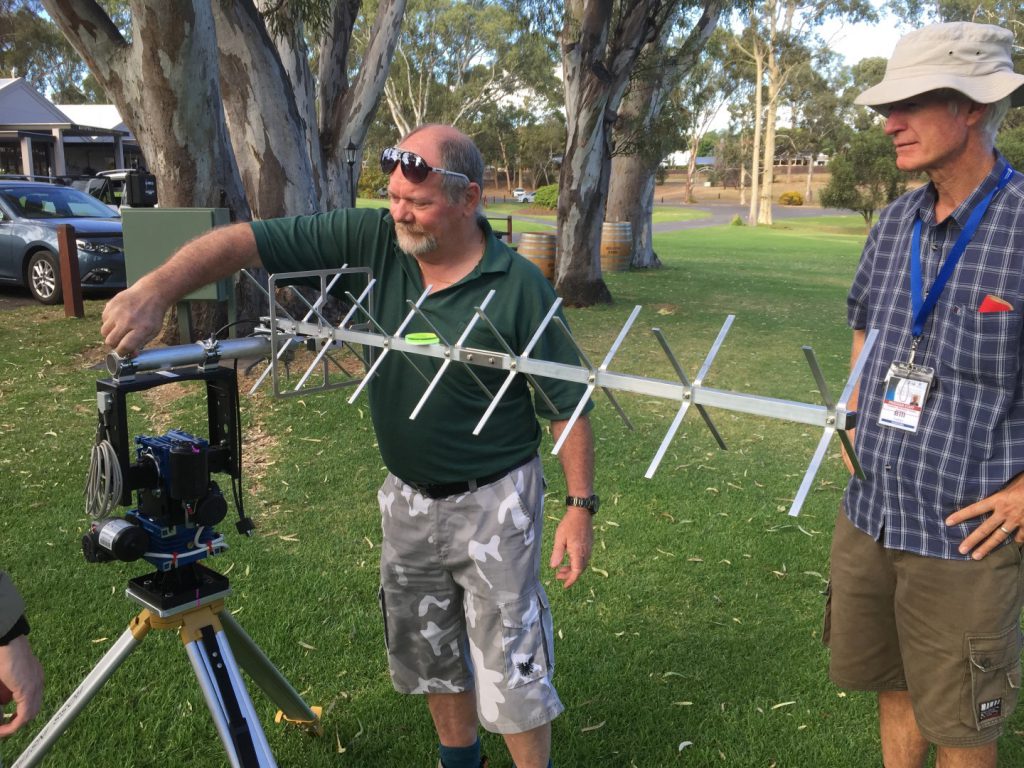
Mark VK5QI’s X-Quad antenna from Wimo generated a lot of interest as well as the tracking rig which now takes GPS data from the telemetry and computes the correct azimuth and elevation to aim the antenna at to receive the balloon. Lots of work went into that system by multiple club members so it was great to see it out in anger.

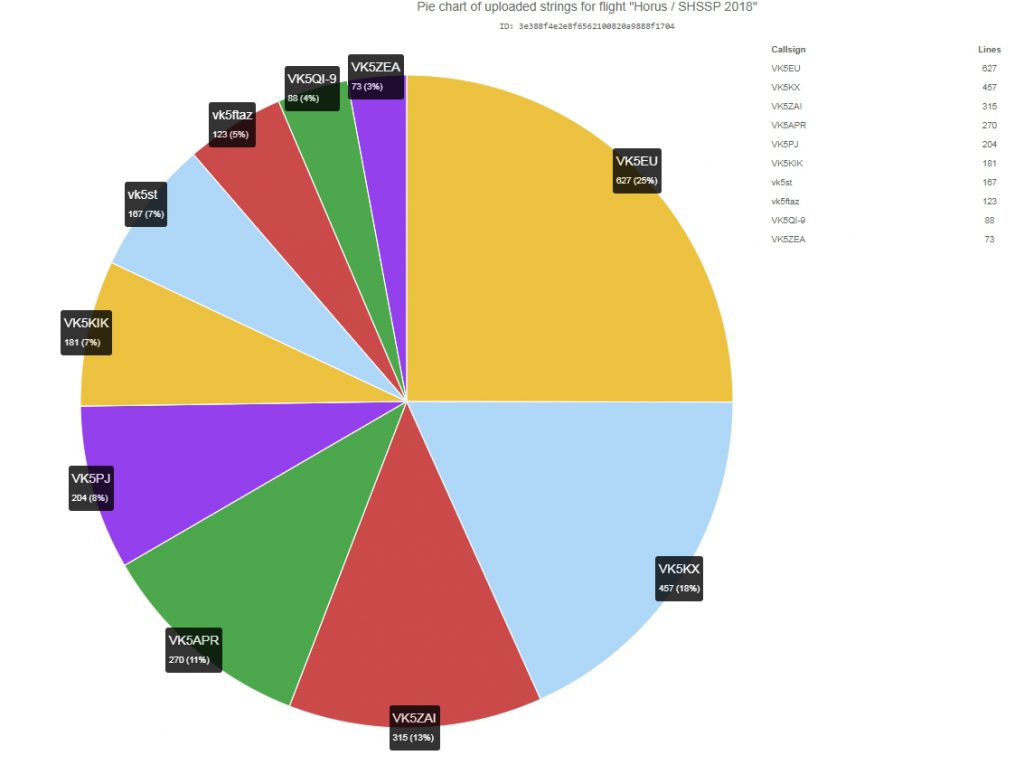
Back in Adelaide, Peter VK5APR and Graeme VK5EU also made major contributions. The Wenet telemetry scoreboard in the end was:

  • VK5KX: 275015 packets (67.14 MB)
  • VK5APR: 153431 packets (37.46 MB)
  • VK5DSP: 13682 packets (3.34 MB)
  • VK5EU: 89418 packets (21.83 MB)
  • VK5QI: 200777 packets (49.02 MB)

Tracking the RTTY payload required some finesse this time as it was an original Micronut complete with AFSK spacing and frequency drift issues of old. None the less multiple stations were able to contribute to the flight data collection.

What the Balloon Saw

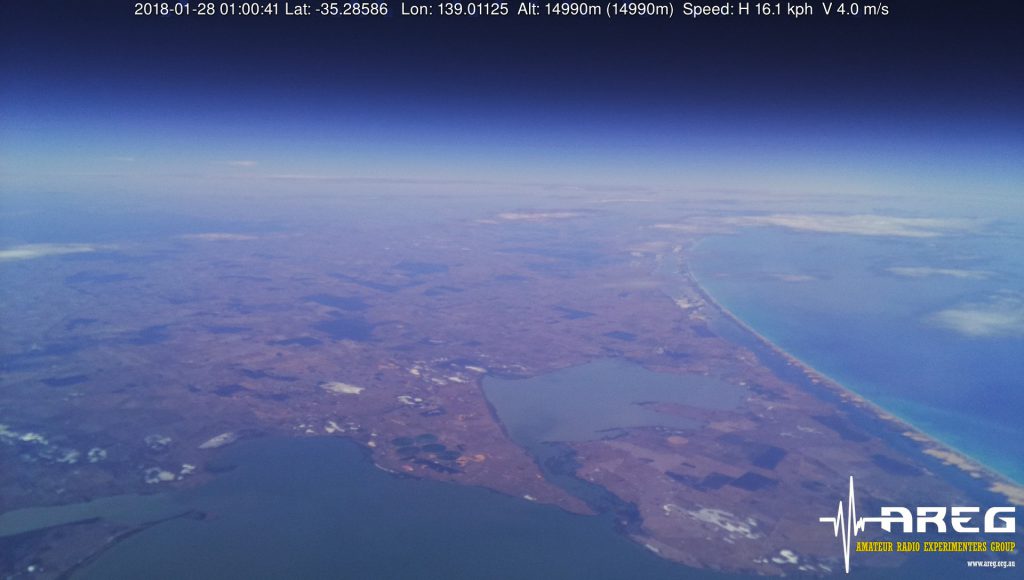
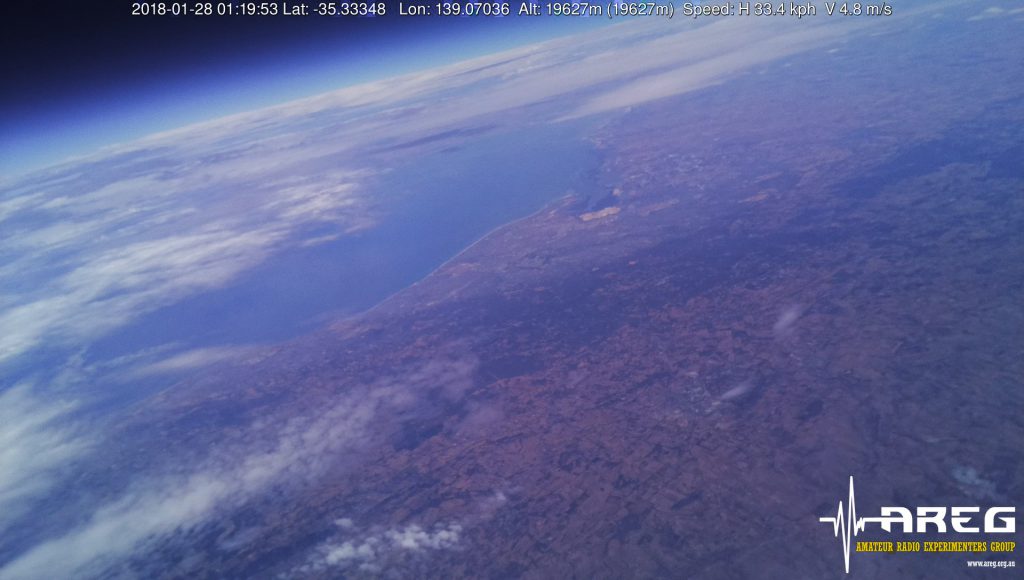
The most spectacular aspect of any of these flights are the pictures collected from the high altitude cameras. These never get old and this flight did not disappoint.

This slideshow requires JavaScript.

(Slideshow from the flight)

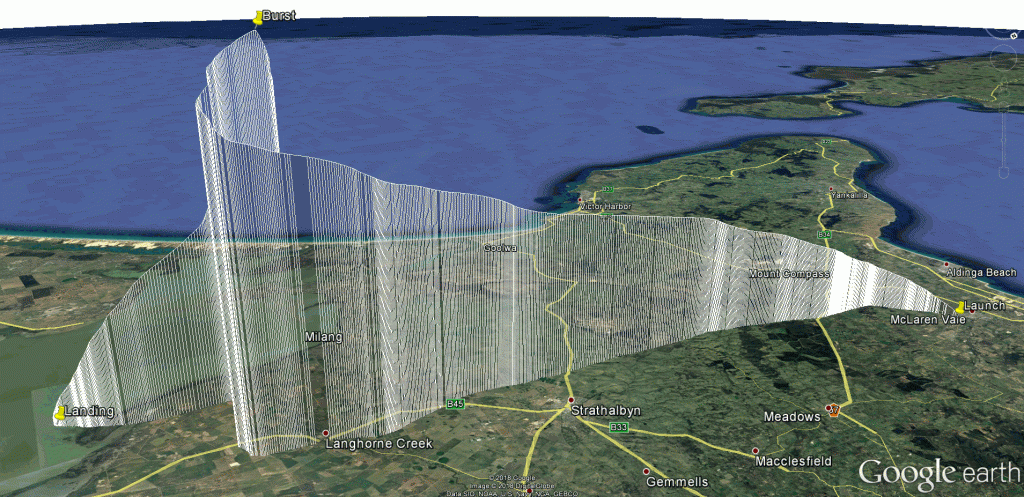
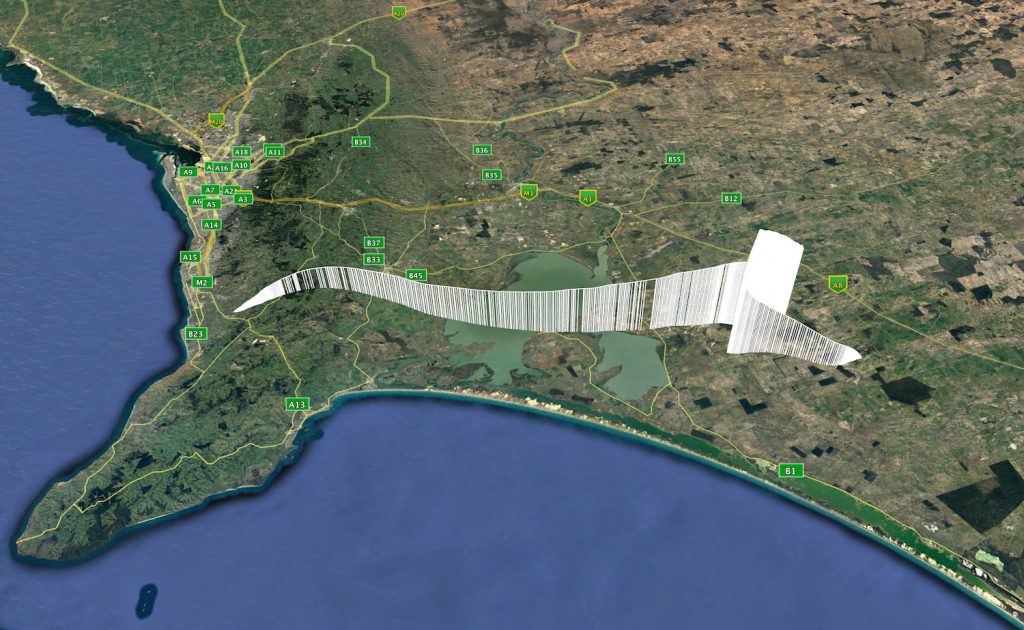
The final flight track looked as follows

The flight stats are as follows:

MetricResult
Flight Designation:Horus 46 - SHSSP18 #1
Launch Date:27/1/2018 23:39:30 UTC
Landing Date:28/1/2018 01:58:43 UTC
Flight Duration:2 Hours 19 Minutes
Launch Site:-35.22103 138.55374
Landing Site:-35.38075 139.1722
Distance Traveled:58.8 km
Maximum Altitude:21,213 m

Attempted Recovery

As with all flights, there is a degree of uncertainty. So with Horus 46, while the expectation was that we wouldn’t be recovering this one, none the less an attempt was going to be made. Mark VK5QI set out with Will VK5AHV to track and attempt recovery anyway.

For a while it was looking positive, but alas this balloon “exceeded specifications” in a most annoying way. It flew higher than planned, in fact nearly 4km higher, which shifted the final landing zone well and truly into the waters of Lake Alexandrina.

Conclusion

A big thank you is again owed to everyone who contributed to the flight either through direct flight operations or through telemetry gathering. Stay tuned as we are still hoping to fly the main scientific payloads next weekend (weather permitting).

Horus 46 High Altitude Balloon Launch Sunday 27th

 The Amateur Radio Experimenters Group has been again asked to support the Southern Hemisphere Space Studies Program for the International Space University in 2018. Held in conjunction with the University of South Australia in Adelaide, this year AREG is launching one balloon for the group carrying a variety of sensors and cameras. The students this year are focusing on space navigation and will be attempting to take the GPS and 9DOF orientation sensor data from the payload to pinpoint where in space the photos were taken from, and then overlay them like a checkerboard over the ground.

The flight will lift off at 10:00am ACDT on the 28th of January from Serefino Winery east of McLaren Vale.

Tracking of the flight will be available on the HabHub Tracker, available at this link. (Note that other balloon launches will also be visible on this page, including the Bureau of Meteorology launches from Adelaide Airport).

Live Imagery from the launch will be available at this link: http://ssdv.habhub.org/VK5ARG

Payload Telemetry Details

UPDATE: Due to the weather, there is now only one camera payload (as well as the RTTY and tele-command systems) planned for this flight, with a much lower planned burst altitude (~17km instead of 30km). This is because of the flight path and recovery concerns in the face of Severe fire-ban and harsh weather forecasts.

  • Primary Telemetry:   434.650MHz +/- 5 KHz RTTY 100 baud 8N1
  • Imagery Payload:   441.2MHz FSK 115k2 baud Wenet

As always we can use the help with receive stations copying the telemetry and pushing this to the internet for us. If you have a Wenet capable ground station please concentrate on the 441.2MHz downlink to maximise the data we collect for the university.

The auto-configure feature within dl-fldigi will automatically configure these settings for you once you pick the correct flight (‘Horus / SHSSP 2018’). The UKHAS tracking guide provides the information you need to set up a RTTY receiver:  https://ukhas.org.uk/guides:tracking_guide

Note that the RTTY payload on this launch is one of our ‘vintage’ MicroNut payloads, and is expected to drift a few kHz during the flight. dl-fldigi will keep track of the signal if it’s within your receiver’s passband, but you may need to re-tune during the flight.

Information on setting up to receive the Wenet imaging payload is available here: https://github.com/projecthorus/wenet/wiki/Wenet-RX-Instructions-(Ubuntu-Debian)

Note that this is a few orders of magnitude more complicated than setting up for RTTY, and requires a machine running a recent version of Ubuntu, some Linux experience, and a RTLSDR+Preamp. You also need to be within 100-150km of the balloon to receive sufficient signal.

The Flight Path

This flight is not ideal as it is landing in the Adelaide Hills, an area that can make recovery difficult for multiple reasons. The planning group are watching this very closely.

A note on the Weather

With the weather in the high forties this coming weekend if the CFS issue a Severe or higher fire ban on Saturday at 4pm then the flight will be scaled back or cancelled. It is possible a light weight disposable flight may still run (without the expensive scientific payloads) so we will still be looking for tracking. It all depends on the flight path and the fire ban status issued by the CFS. A final call will be made Sunday morning and will be posted to the AREG Website before launch.


Next Meeting: Chasing DX (or how to work 3Y0Z)

Welcome to 2018!

The Amateur Radio Experimenters Group Monthly Meetings are starting up again with one of our Beginners Series  of talks, but this one will have a twist. We will be running it as a panel discussion with the topic “HF Operating Etiquette – How to Work 3Y0Z”, and wish to invite all of the active DX chasers and HF operators in the room to share their collective thoughts on what to do and what not to do when chasing HF DX in general.

The aim is to spread the collective knowledge about how to get through those piles for that special ATNO (All Time New One) like the Bouvet Island DXPedition (#2 on the most wanted list). Topics will be guided by moderators and will include HF operating etiquette, how to work HF split, how, when and where to call in a pileup, what to consider propagation wise and much more.

We will have a live scribe taking down all of the best ideas and will post them here after the meeting for future reference.


Where and when is the meeting?

Friday January 19th – 7.45pm (for an 8.00pm start)
Fulham Community Centre, Phelps Court, Fulham.

Visitors are most welcome to come and participate in the evening. We hope to see you there!

[wpgmza id=”5″]


VK5RWN D-Star repeater site antenna tower replacement.

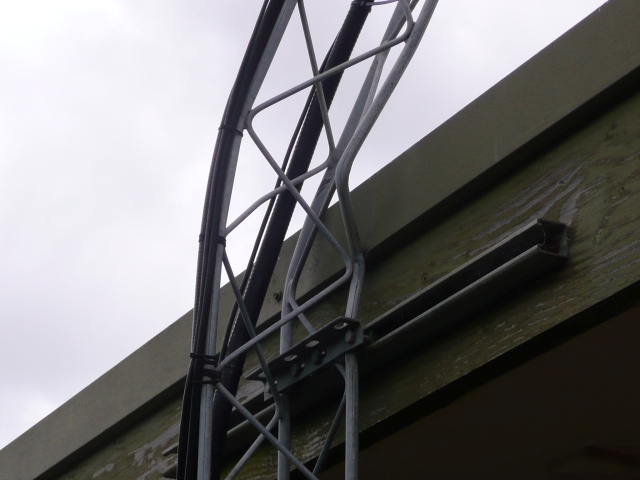
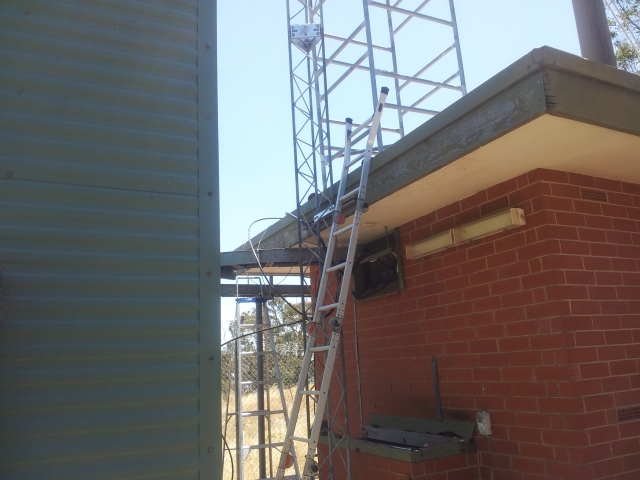
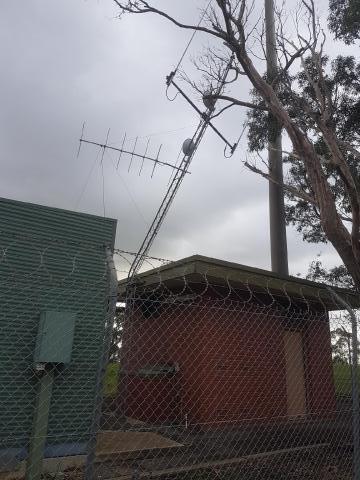
Back in mid August 2017, the tower supporting the antennas for the VK5RWN D-Star repeater system was damaged during the big blow that accompanied the storms. The tower, which was a section of a Hills Telemast bolted at the roof line of the communications hut, has been in service for about 27 years and was in good order. It appears that the wind loading had been exceeded during the August storms and the tower was bent just above the roof line of the building and the top section with the antennas was approximately 30 degrees off the vertical.

Well, no option, it had to be replaced!

The working bee at the VK5RWN site was scheduled for Tuesday 19 December 2017.

Ben VK5BB was at the site around 0845 hrs local time and the other members of the work crew arrived shortly afterwards.

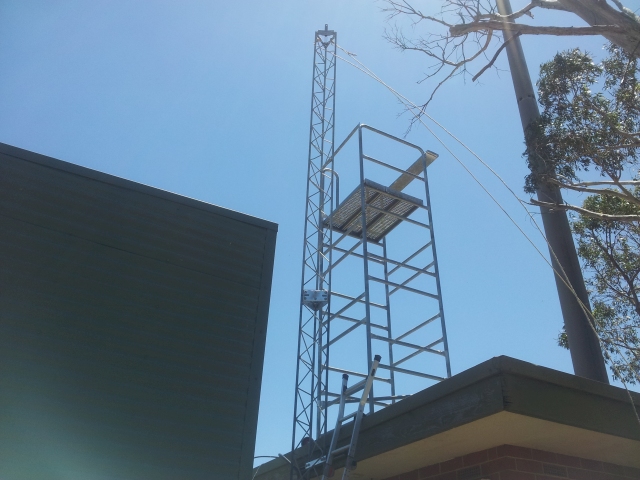
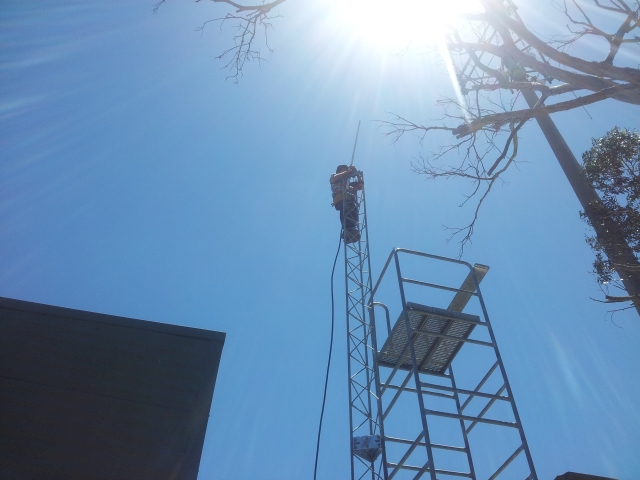
Apart from initial preparations, and the OH&S site survey, the first job of the day was to erect the scaffolding, on the roof of the building! Gave us very easy access to all antennas for disassembly. The scaffolding was also used for the reassembly, thereby minimising the need to actually climb the tower, though Colin VK5ACE later did, to re-mount the 2m antenna at the top.

From there the antenna equipment was easily removed and the bent tower was cut off just above the bend in the tower (just above the roof line) and the tower easily removed. The coaxes were laid out to one side so as not to be damaged and ready for re-installation.

Whilst the old tower was being removed, other members bolted the new tower sections together ready for erecting. The new tower is two sections of Hills 330mm Butt Section mast, with additional plates fitted at the join of the two sections to provide some additional strength at the join.

The top end of the new tower was lifted (man-handled with ropes) above the adjacent hut and then the base lifted into position near where it was to be mounted. Using the ropes, the tower was then pulled upright, across the gap between the two buildings to its mounting position, loosely bolted in place whilst we marked out where the base bolts were to go, drilled and fitted the Dyna bolts and the tower was firmly bolted in place. Actually went in place quite well with a minimum of jiggling etc!

Lunch time! (about 1300 hrs local)

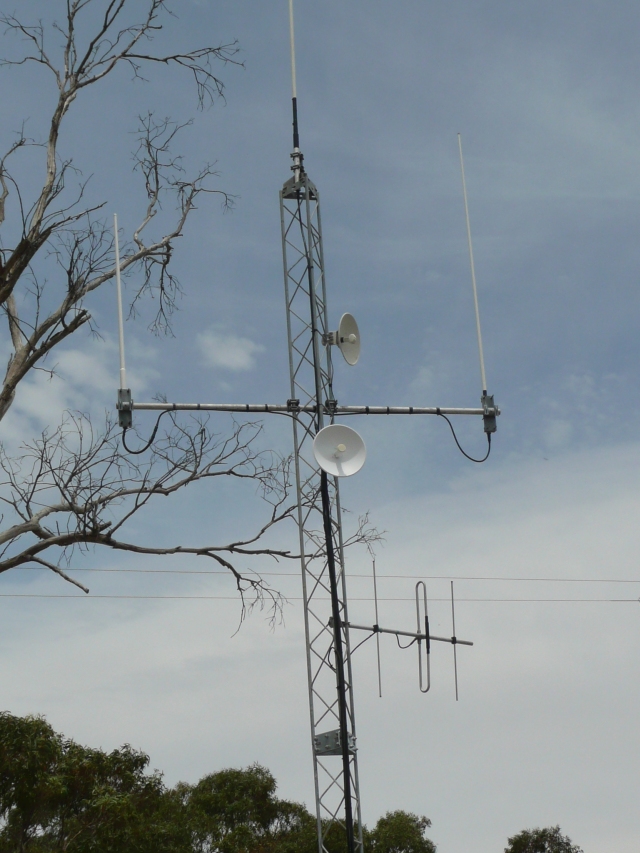
After lunch, the antenna cross arm and antennas were refitted, thanks to Colin VK5ACE, the main climber/rigger for the day. As the Wi-Fi dishes were refitted, the day started to get a bit blowy but the dishes were pointed approximately in the right directions. The 2m 7 element Yagi for the Broadcast Source transmitter was re-installed as a 3 element Yagi and pointed at Crafers. All coaxes were resealed, dressed and cable tied to the tower.

All antennas are back in their old positions, determined by the lengths of the various coax feeds. The tower, now 9m high, carries a 2m, a 70cm and a 23cm vertical “white stick” collinears, two 200mm Wi-Fi dishes and a 3 element 2m vertical Yagi.

Job done!

All equipment was turned on again and the various systems tested, we even had the Internet back on at the site, so we did get the dish right, either that or it has strong side lobes. (The Internet connection was previously still working even though the dish was pointed at the sky? A relay from the ISS??)

Clean up, and we were gone by 1700 hrs local.

The D-Star operations were checked at the site and later again from Ben’s QTH and all was good, including remote access to both the D-Star and the Broadcast computers.

Crew on site;

  • Trevor, VK5ATQ, roustabout and also supplied the scaffolding, (NERC member)
  • Rod, VK5ZRK, roustabout, (NERC member)
  • David, VK5MDF, roustabout, (NERC member)
  • Colin, VK5ACE, rigger, (AREG member)
  • Jeff, VK5IU, “supervisor” and roustabout, (AREG member)
  • Ben, VK5BB, project manager, 2nd climber/rigger, (AREG member)

Many thanks to the crew who helped during the day and especially Olga VK5FOLG, as she supplied a fresh cut lunch for all and delivered on site about 10 minutes before the lunch break.

Reports from the D-STAR users have reported a significant improvement of signal strengths at Balaclava and Mt Barker on 2m and from Hallet Cove on 70cm, so all appears to be good again.

Next task for the VK5RWN D-STAR system is the upgrade of the computer to a new 64bit system running CentOS 7 64 bit and the new G3 gateway software. This is scheduled for early in 2018.

Willunga High School Launch – Success!

This slideshow requires JavaScript.

On the 7th of December 2017, members of Project Horus participated in the successful launch of the Willunga High School’s 2017 balloon launch. This year Willunga High School was participating in a ‘Balloons Without Borders’ exchange program with the United States ‘Near Space Systems’ – Near-Space Systems would launch Willunga High School’s payload, and the US payload would be launched here in Australia. The US payload contained cameras and various atmospheric sensors.

NearSys BalloonSat Payload

The chase team consisted of Mark Jessop VK5QI, and Matthew Scutter, the developer of SkySight.io, a weather prediction service that Project Horus has made use of many times for launch-day weather predictions. This was Matthew’s first balloon chase, and as is custom, he got thrown straight into the deep end acting as navigator and operator of the chase car software.
Mark describes the launch day as follows:
We launched right ahead of a cold front that was moving in, which threatened to make the flight challenging. During my drive to the launch site I encountered large areas of showers, however the Willunga area stayed clear for quite a while. 
The winds did start to pick up during launch preparations, but were not strong enough to make the launch difficult. We ended up with a total payload mass (combined across the 2x telemetry payloads, 1x Wenet imagery payload, and the BalloonSat) of approximately 1300g.
The flight proceeded pretty much as planned, with an average ascent rate of 5.2m/s. The payload’s ground speed was observed to reach 200kph at some points during the flight. The balloon was cut away at just under the predicted burst altitude of 30km, in an attempt to bring the landing site closer towards the Dukes Highway, a major highway running through the region. The maximum altitude was 29949m. 
The descent rate was faster than expected, around 10m/s on landing. This turned out to be due to one of the payloads tangling with the parachute, causing it to not open completely. This brought the landing location a bit further away from the highway, and made the descent portion of the flight too fast for the our lonesome chase team to get to the landing site in time to watch the landing. 
We arrived about 20 minutes after landing to find the payload in a large, recently cropped field, about 200m from a road. Shortly after we departed, the cold front arrived and the rain started – we had recovered just in time!
All the payloads were recovered in good condition, in spite of the faster-than-expected landing. Constructing the payloads from lightweight expanded polystyrene does have its advantages!
The live Wenet imagery didn’t perform too well, mainly due to lack of receivers. I had a receiver running in my chase car, and Graham VK5EU did a great job of receiving from home.
Thanks also go to VK5HS, VK5APR, and VK5NEX for decoding the RTTY telemetry throughout the flight!
 The flight profile and chase vehicle tracks can be seen here.
The flight statistics are:
MetricResult
Flight Designation:WHS-December 17
Launch Date:07/12/2017 00:11:45 UTC
Landing Date:07/12/2017 02:08:09 UTC (Approx)
Flight Duration:1 Hour 57 Minutes
Launch Site:-35.262946 138.555586
Landing Site:-35.755356 139.736493
Distance Traveled:124.8 km
Maximum Altitude:29,904 m
Thanks to everyone involved in yet another high altitude balloon flight!

Adelaide Rally using VK5RSA / VK5RSB Repeaters

WICEN has approached AREG to help with their communications nets during the Adelaide Rally this year on the 7th,8th and 9th of December. For the most part, WICEN will use the VK5RHO Ansteys 2-meter repeater (146.850) but for 2 other stages they are requesting to use the VK5RSA 70cm repeater (438.025). AREG is very supportive of this type of use of the club repeater assets and so naturally has agreed.

The times and stages are:

  • Thursday – Old Norton Summit (approx 2:30pm till 5:30pm)
  • Saturday – Norton Summit (approx 12:30am till 5:00pm)

WICEN may also require access to Summertown VK5RSB (439.900) as a possible backup for a Saturday afternoon stage.
WICEN’s role is backup communications and radio traffic should be minimal.

Amateurs who hear the rally traffic on these repeaters are asked to give WICEN priority access during the event. Your cooperation is greatly appreciated!

High Altitude Ballooning: Willunga HS Supported by Project Horus

The Willunga High School is planning to launch a high altitude balloon, planned for this Thursday, the 7th of December. Launch time will be around 10:30 AM ACST. This flight is being carried out by the teachers at Willunga High School.

While not a direct Project Horus Flight, it is being supported by the Project Horus team with tracking payloads, recovery services and telemetry feeds. Amateur Radio operators from across the state are invited to contribute to the telemetry collection activities which will use the same Internet resources as Project Horus does.

Flight Predictions

The predictions are a bit variable – there is a weather change coming through Thursday & Friday which are throwing things out. As of Sunday 3rd December’s model the balloon is landing somewhere near Ki-Ki, but this is expected to change. If the predictions change markedly, the launch may be rescheduled to Friday.

Target burst altitude is 30km, but depending on predictions the flight may be cut-down early to ensure a safe recovery.

The radio payloads on this launch are currently planned to be:

  • RTTY Telemetry – 434.650 MHz
  • Cutdown / Mission Control payload – 431.650 MHz
  • Wenet Imagery on 441.200 MHz

As usual, assistance with tracking is greatly appreciated.
Information on tracking the RTTY payload is available here: https://ukhas.org.uk/guides:tracking_guide

Live tracking of the flight will be available on the HabHub Tracker: https://tracker.habhub.org/#!mc=-34.8,139.0&mz=9

Finally, if we can get enough packets down from the Wenet payload, live imagery will appear here: http://ssdv.habhub.org/VK5ARG

More news as we get closer to the day!